
Equipment at Starfront
Astro-Physics 130 EDF Gran Turismo
Astro-Physics Mach1 GOTO mount
ZWO ASI 6200MM Pro camera
ZWO 7x2” Filter Wheel with RGBLHaO3S2
Baader guidescope
ZWO Camera angle adjuster
ZWO Electronic Focuser
ZWO ASI Air Plus
Deep Sky Dad OFP2
Mac mini
Starfront Observatories Astronomical Image Gallery
This gallery features images acquired by me with my equipment at the Starfront Observatories in Coleman, TX.
I have been blessed to be in astrophotography long enough to go from manual guiding at the eyepiece on film to controlling my own telescope gear from an amazing dark/clear sky location like Starfront.
For more on the observatory and my experience in preparing the equipment, delivering the equipment, and accessing the equipment remotely,
please see the “Video Library” page for 3 unique videos covering that topic.
For technical details on the images, please visit by Astrobin page linked here.
Please click on any image for a larger view in Lightbox mode.
Angels in Monoceros: The Monoceros Molecular Cloud Complex
The Monoceros R2 molecular complex (often shortened to Mon R2) is a massive giant molecular cloud and one of the nearest active star-forming regions to Earth. It's a dynamic stellar nursery embedded in dense gas and dust, where new stars—particularly massive ones—are actively being born.
Key Facts
Location: Southwestern part of the constellation Monoceros (the Unicorn), near the border with Orion. It's part of the larger Orion-Monoceros cloud complex.
Distance: Approximately 2,400–2,700 light-years (around 830 parsecs).
Size and Structure: The main dense core is relatively compact (a few light-years across), but the overall molecular cloud and associated nebulae span a wide area—reflection nebulae alone stretch up to about 2° in the sky. It's situated well below the galactic plane, which makes it stand out in certain observations.
Age and Activity: Star formation here began roughly 6–10 million years ago. It hosts an OB association (young, hot, massive B- and A-type stars) that illuminates surrounding dust, creating prominent reflection nebulae with bluish hues. There's also significant emission from ionized gas (red glows) and dark nebulae that appear as shadowy silhouettes blocking background light.
Notable Features:
A central hub of massive star formation with embedded clusters, molecular outflows, and HII regions.
Infrared observations (like those from VISTA or 2MASS) penetrate the dust to reveal hidden young stars and protoplanetary disks.
It's a key site for studying early stellar evolution, variability in young stellar objects (YSOs), and the interplay between massive stars and their natal clouds.
The most famous and photogenic part of Mon R2 is the region around NGC 2170 (the Angel Nebula), a striking reflection nebula with wing-like dust structures, glowing blue from scattered starlight, mixed with red emission and dark lanes. Wider views of the complex reveal a richer tapestry of colorful gas, dust filaments, and star clusters.
Credit: GROK 2/28/26
Click on image for larger view.
California Nebula in SHO (NGC 1499)
This nebula that resembles the state is really long at over 2.5 degrees in length in the constellation Perseus. My data comes from a classic SHO presentation, which I cover a bit in the Seagull nebula image below. The SII data is very striking when viewed at higher resolution. The data is very detailed and wispy. This is one area I would love to explore with a longer focal length instrument. The area is not far from the Pleiades Star cluster and they are often imaged together in wide-field captures.
the nebula is about 1,000 - 1,500 light years distant
about 100 light years long
an emission nebula with pretty strong signal in all 3 narrow band channels
link to astrobin for image acquisition and plate solving for more deep sky references
Medulla Nebula (CTB-1 or Abell 85)
A 10,000 year old supernova remnant, the faint CTB-1 in Cassiopeia is a challenge to photograph. The imaging details are always available on Astrobin, but this image represents over 78 hours of imaging time under the pristine skies of central TX.
A central pulser powers the nebula confirmed by x-ray data
The main object is larger than the full moon on our skies and is 100 miles in diameter
it is approximately 10,000 light years away in Cassiopeia
Link to astrobin data and image plate solve for more details on surrounding deep sky objects
Seagull Nebula
IC 2177 and other NGC, VdB, Sh2 objects. Please see the astrobin link for plate solve data and image acquisition data.
Seagull Nebula in SHO (Sulpher II/ Hydrogen Alpha/Oxygen III)
Seagull Nebula in classic RGB
The Seagull is beautiful in classic RGB mapping. This image is a classic straight Red/Green/Blue filtered capture with a monochrome camera. The Seagull is fairly far south in the sky and Starfront helps open up this region for imaging to me as the hills of West Virginia block my southern horizon from my backyard.
The nebula is about 3,700 light years away on the border of Monoceros and Canis Major.
An emission nebula that spans about 1,100 light years.
the key star is HD 53367, which is located in the bottom right quadrant of my image. This star is a triple star system
the star system is very young and provides energy to the star-forming region
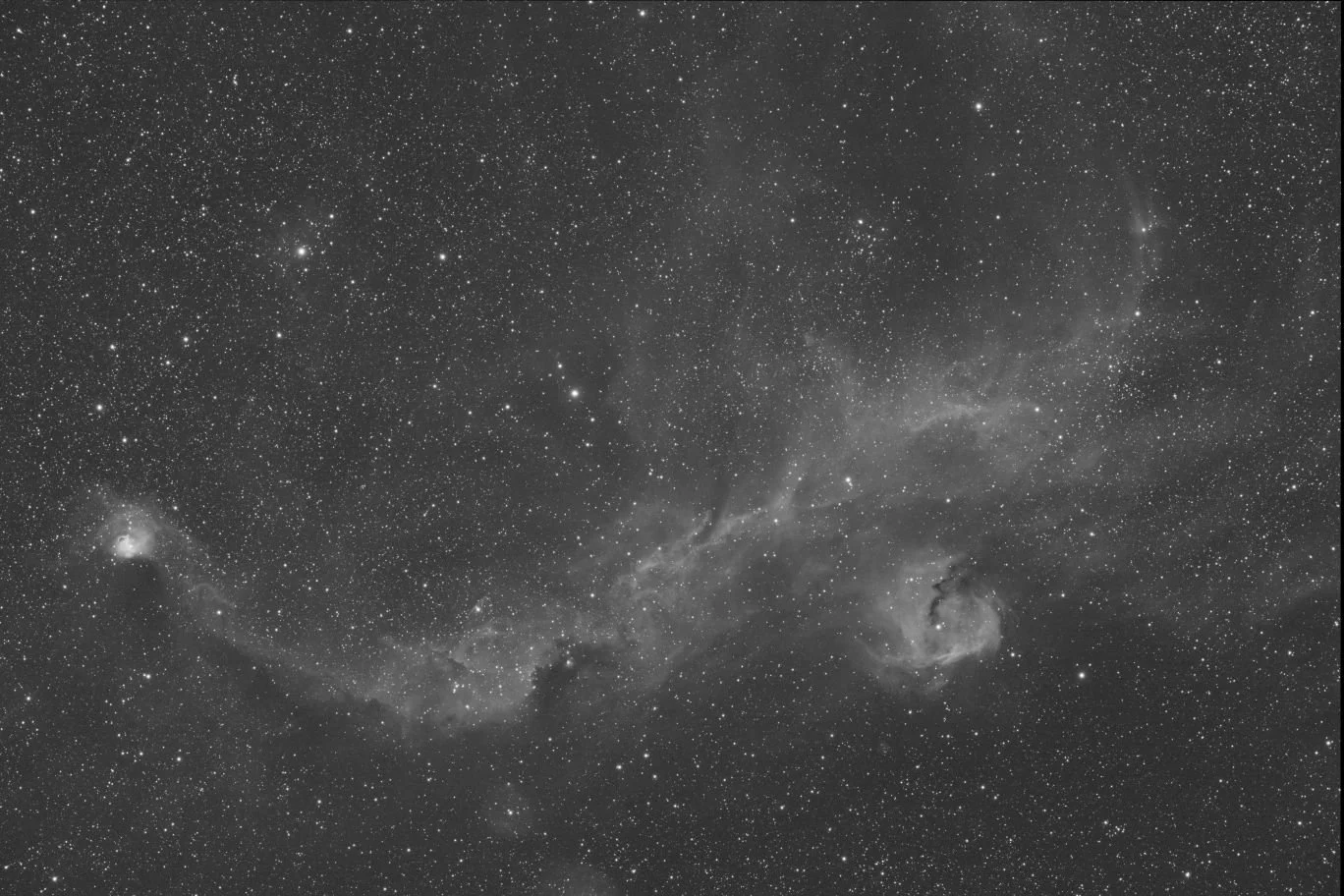
Sulphur II channel
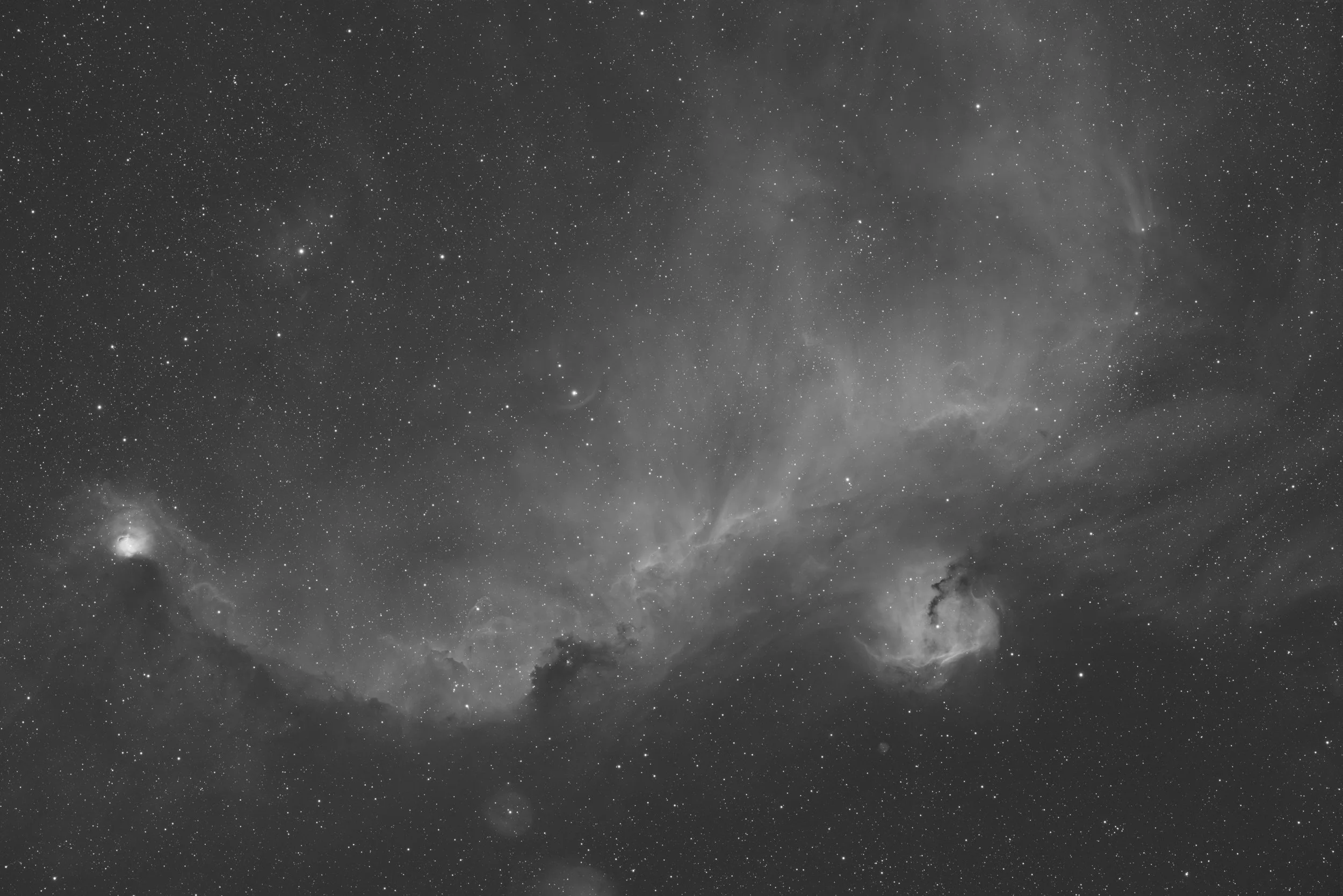
The three independent components are shown here. The Sulphur II channel is mapped to the Red color space. SII captures emission lines at 672nm. The Hydrogen Alpha is mapped to green and captures emission at 656. Imaging time can be seen at the Astrobin website. I tend to over-index on SII and OIII to overcome the strong Ha signal that will be mapped to the green color channel. The OIII is mapped to blue and captures doubly ionized oxygen at the 496 and 501nm.
The Hydrogen Alpha channel of the Seagull Nebula
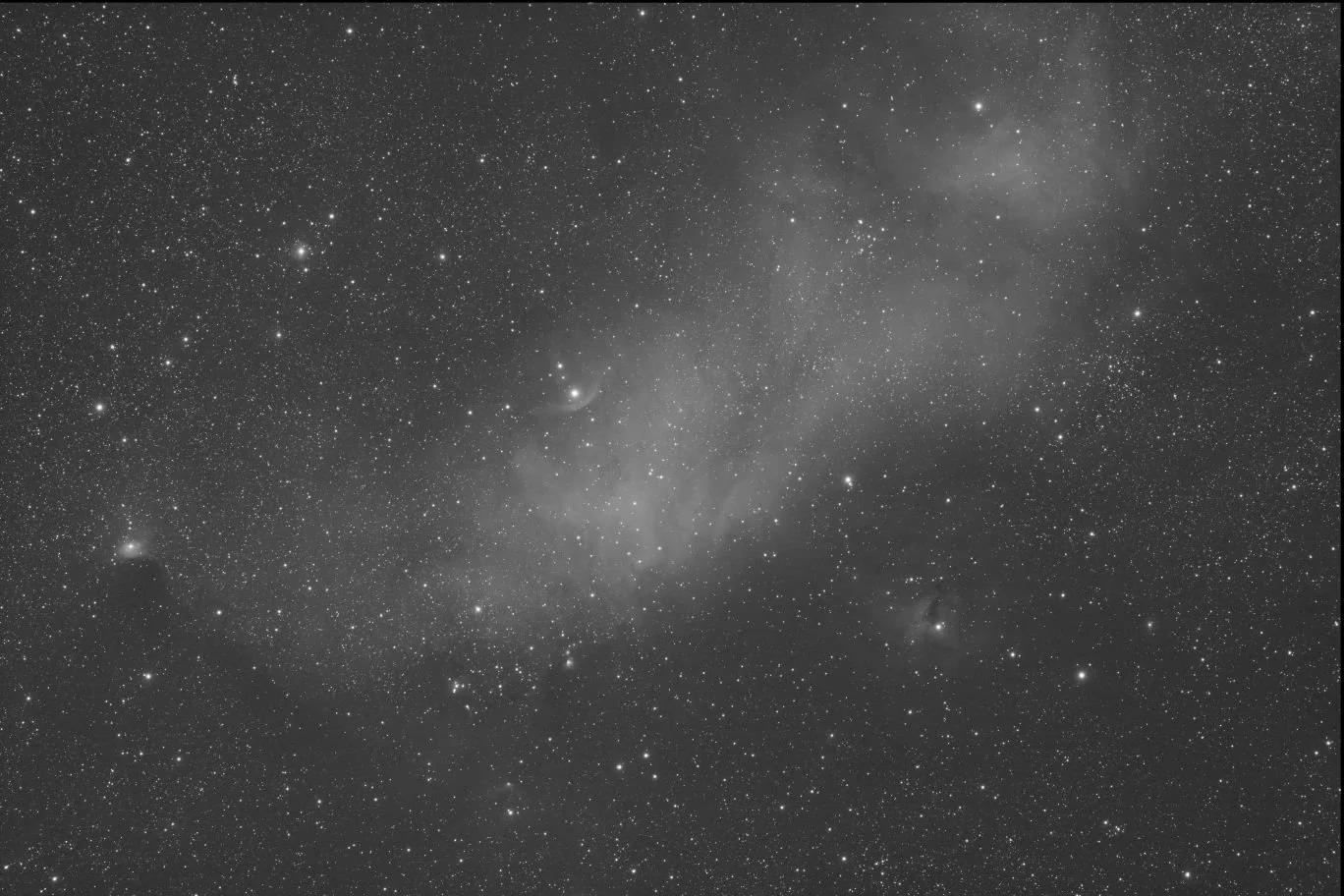
Oxygen III channel
“Le Calamar” - Squid Nebula (Ou4)
What an amazing object in the constellation of Cepheus. The blue Squid nebula is a recent discovery by a French amateur astronomer, Nicolas Outters and explains the designation Ou4. Nicolas nicknamed the object “Le Calamar” (French for squid) due to its shape.
It is extremely faint and for my image required over 35 hours of Oxygen III filtered data to bring out the structure.
The Squid is embedded in the red Flying Bat nebula or Sh2-129.
It is large in size on the sky spanning over 1 degreee or about twice the width of the Moon.
It is 2,300 light years away and about 50 light years across.
It is larger than the Orion Nebula.
Current research indicates it is a bipolar outflow driven by powerful winds or eruptions from a hot massive triple star system at its center.
Helix Nebula - The Eye of God (NGC 7293)
One of the advantages to imaging from Starfront is gaining access to southern objects I would have difficulty imaging from my home dark sky sites. Now, the Helix does rise above my horizon here at 38° north, but I cannot access it from my backyard due to the hills and trees. So, I would need to go to my remote locations and I have never been able to sync up clear skies that far south with a trip to my dark sky locations.
That made Helix one of my primary targets once the system was up and running at Starfront.
Some interesting tidbits on the Helix nebula
closest bright planetary nebula at just 650-700 light-years away
despite it’s appearance from Earth, it is a complex prolate spheroid or elongated bubble
it contains thousands of planetary knots (~40,000) blob-like structures. Each knot is roughly the size of our solar system
this nebula offers a preview of what our Sun might look like in ~5 billion years
it is located in the constellation Aquarius
Eagle Nebula and Comet C/2025 R2 (SWAN)
The Eagle meets the SWAN on October 17, 2025 from Starfront Observatories. I have a video on the library page dedicated to this event with all of the details. One of the great surprises of moving my imaging gear to Starfront was the convenient access I now have to any worthwhile comets in the northern Hemisphere. So far, I have imaged 3 different comets with videos and still images. It has been a blast. While R2 (SWAN) wasn’t striking on its own, the pairing with the Eagle Nebula (M16) provided a wonderful contrast in astronomical color. The teal of the comet coma agains the Hydrogen Alpha red of the Eagle nebula. I was so happy to get this image and fingers crossed for many more comet opportunities in the future.
Comet C/2025 A6 (LEMMON)
Comet C/2025 A6 (LEMMON) on October 26, 2025. The ion tail of LEMMON was pure entertainment. Changing from night to night.
My inexperience with imaging comets with a telescope was a challenge to overcome. Eventually, with the help of Adam Block tutorials, I was able to successfully capture and process comet still image.
Comet LEMMON on November 7, 2025. I have a full video dedicated to the comet’s visit to the solar system including a video of one of the disruptive events in the ion tail. Please check it out on the Video Library page.