Al Nagler Interview Podcast
The audio portion of the Al Nagler interview for Podcast subscribers. Mr. Al Nagler, founder of TeleVue Optics, discusses his astrophotography endeavors. A wonderful insight from one of the industry icons.
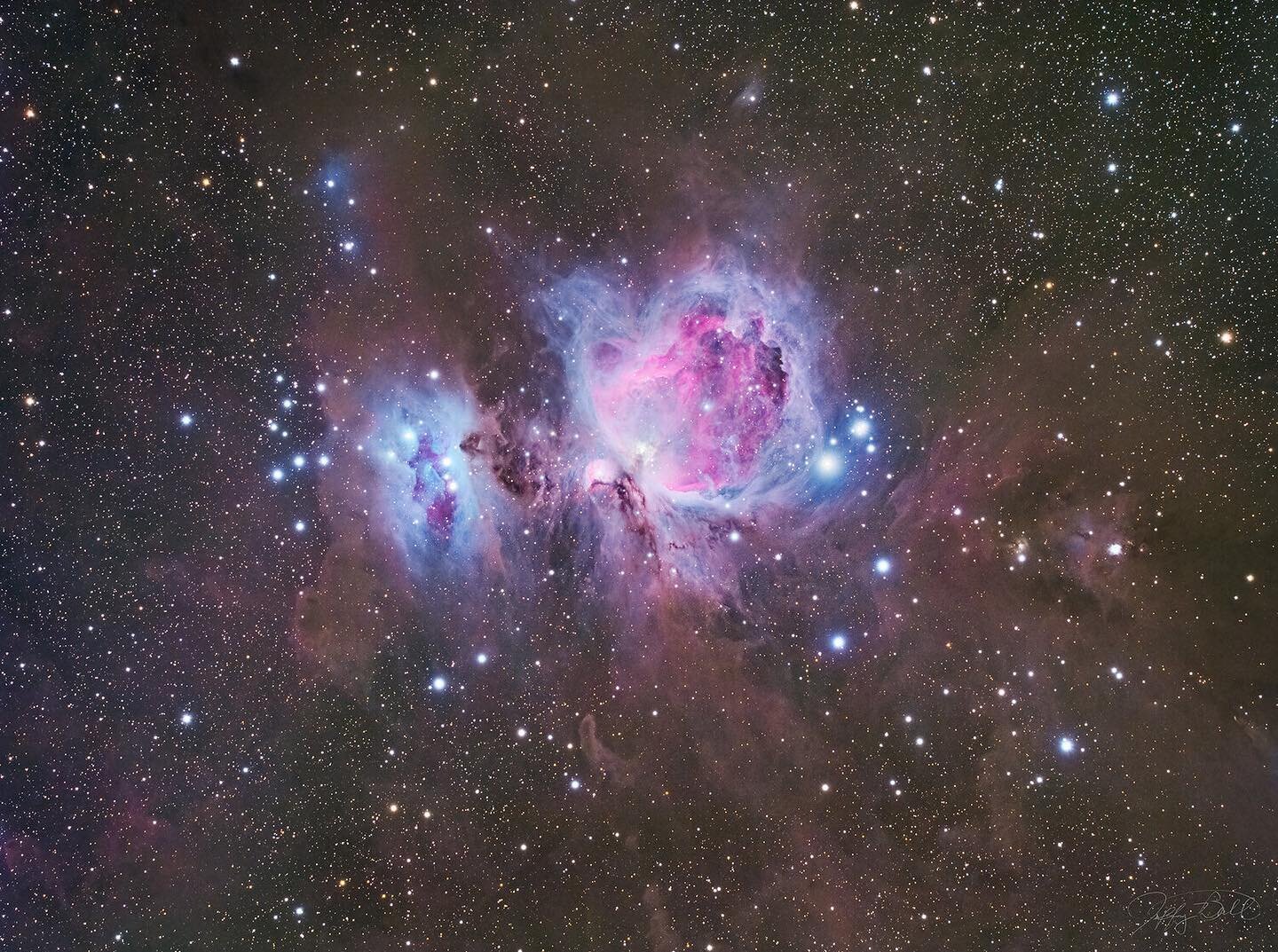
The Great Nebula in Orion
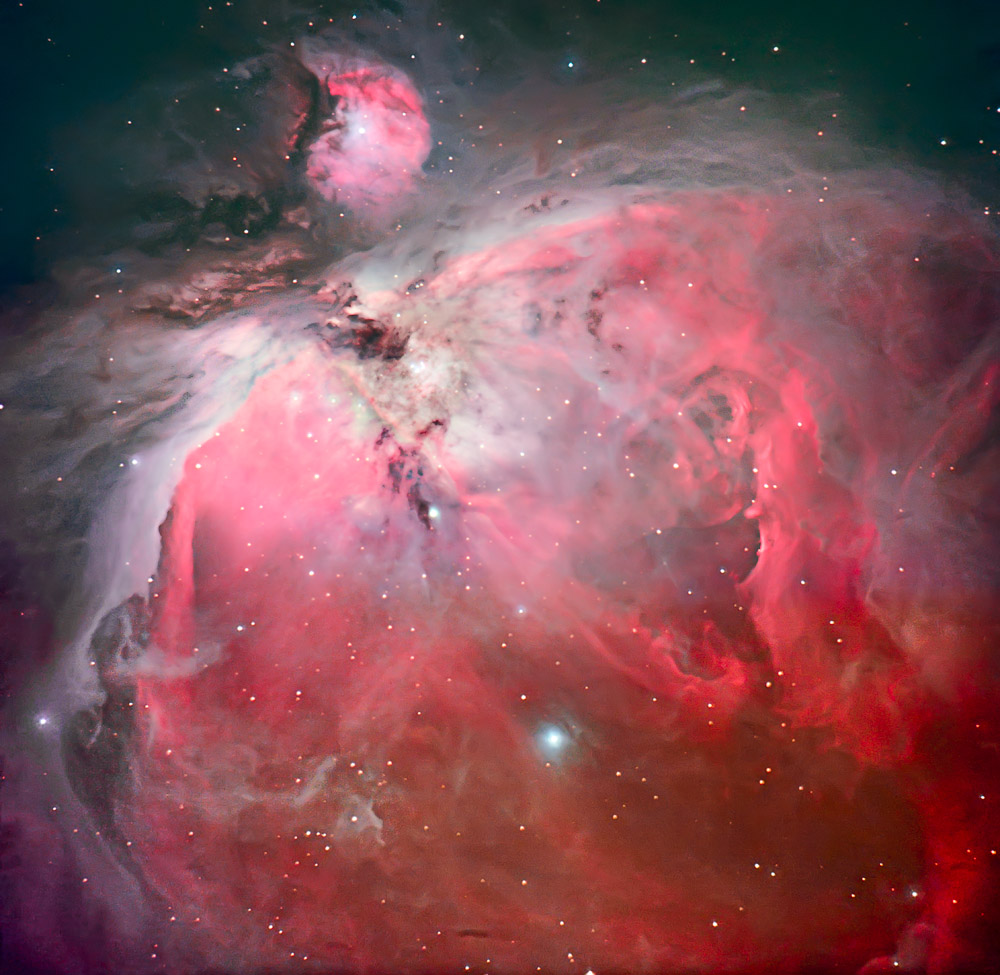 The Great Nebula in OrionI continue to be amazed at the newest Digital SLR technology. My friend and astroimaging partner Brent Maynard performed the necessary modifications on one of the latest cameras from Canon, the T1i. You can find a blog post about this modification by clicking on the "equipment" category or going to the post on January 30. The latest crop of DSLR are offering mind-boggling ISO 3200 and 6400 ISOs and so I just had to test the performance of these cameras at that ISO. All of this is driven by the "expose to the right" mantra espoused by Michael Reichmann (look for a future blog on this.) So the modified Canon T1i gathered first light at the Winter Star Party in Febuary 2010. I mainly imaged at ISO 3200 and found the results to be outstanding. Upon returning home, the previous blog recounts my motivation for trying the new camera in our own Donald C. Martin Observatory. Although now I wanted to give the ISO 6400 a try with a light pollution filter in the camera body to aid in gathering a high quality signal.
The results are posted today of M42, The Great Nebula in Orion. It was a very nice first experiment with the gear and I can't wait to work on some of the summer Milky Way objects with the C14 scope and AP 1200 mount with the Canon T1I camera.
The details of the image are that it is a mosaic of two frames, each with approximately 50 minutes of data comprised of individual 1 minute exposures at ISO 6400. There was a third group of exposures used to capture the dynamic range of the core where exposures where 5 seconds in duration for 1 minute total. All images were processed in Adobe Light Room, the TIFFs were then stacked in Deep Sky Stacker and the combined image was processed in Adobe Photoshop CS4.
I hope you enjoy the image and I look forward to capturing more Milky Way objects this summer. Please click on the image to access the color gallery and then click on the Great Orion thumbnail for a larger presentation.
An underutilized tool...
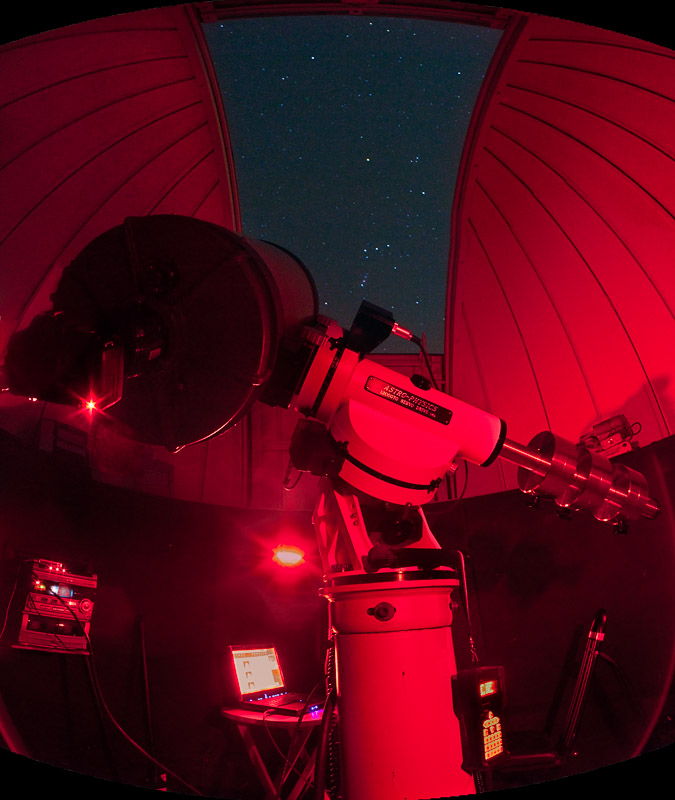 Imaging Orion from the Donald C. Martin ObservatoryOur local astronomy group and high school are very fortunate to have a wonderful astronomical tool at their convenience. Unfortunately, it is severely underutilized and I am also guilty of not putting the tool to use as often as I should. So recently after a public observing night, I committed to imaging M42 from the dome. The observatory houses a 1970's vintage Celestron 14" Schmidt Cassegrain telescope. The scope still performs marvelously and was refurbished a dozen years or so ago. The scope is housed in a similarly aged Ash dome. What has really made the scope perform wonderfully is the relatively new Astro-Physics 1200 GTO mount. The mount was made for the rather bulky C14 and the two perform flawlessly together.
The dome is located just south of the main city limits of Huntington, WV and is victim to a fair amount of light pollution. But recent developments in DSLR technology and filtration have made imaging some objects from the dome a workable situation.
My recent experimentation with the new crop of DSLR's show amazing signal gathering without a compromise in noise at ISO's as high as 6400. 6400 ISO is nuts...right? The DSLR manufacturers have really come a long way in their software/hardware combinations to improve signal while reducing noise. Combining this type of camera sensitivity with a light pollution filter permits imaging of certain objects in the hydrogen alpha range of light. I won't go into detail about all of the technicals around this, but basically most astronomical objects glow at the magical hydrogen alpha line of light and fortunately most of our light pollution does not cross that wavelength and can be filtered out.
So I will post separately my first image from the D.C. Martin Observatory and I look forward to working more frequently with such amazing equipment. I believe I can fulfill many artistic objectives with this gear in the future.
Eta Carina from Winter Star Party
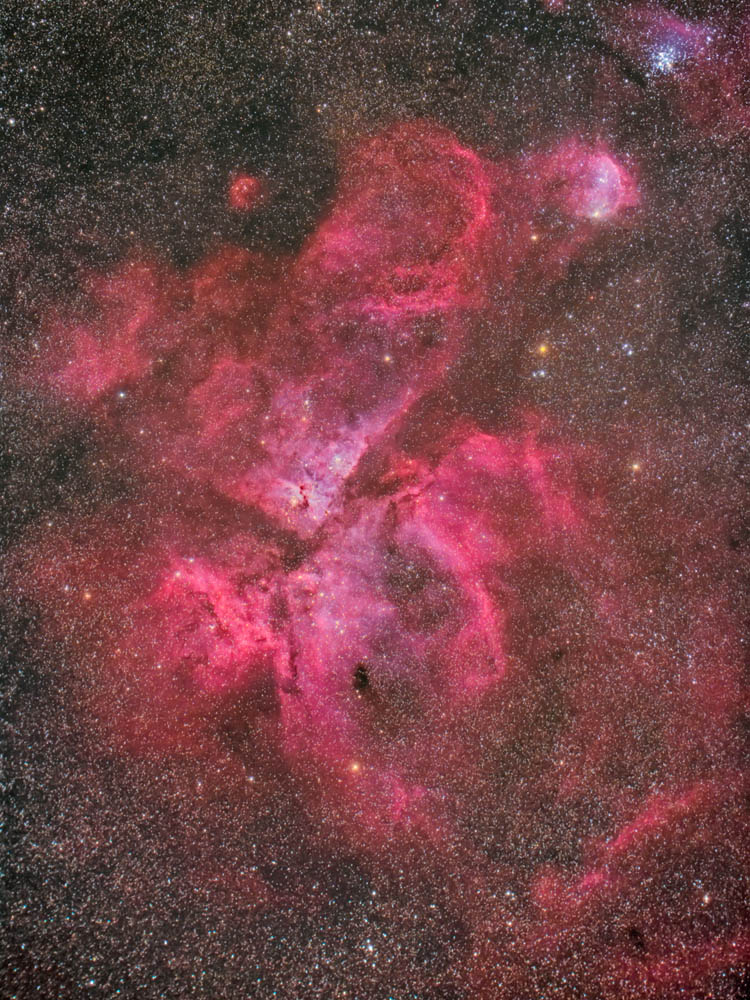 The Eta Carinae NebulaA rare opportunity...to image Eta Carina from the northern hemisphere. I have been to WSP on three occasions and finally had a night for the ages. The transparency on the night of February 11 was incredible. I typically don't hold out much hope for transparent skies down to the horizon where most of the time ocean haze and persistent low clouds tend to hang out. On this night after gathering some very good data on the Witch Head Nebula, we started to get excited about the possibilities of imaging Eta. Our group of imagers began monitoring the sky quality on the ocean horizon early in the evening and we were seeing stars lower and lower as time passed.
Eta climbs only a meager 8 degrees or so above the ocean from 24 degrees north latitude on Big Pine Key. We were easily seeing stars at this elevation and even lower, nearly all the way to the ocean horizon. After completing the data acquisition on the Witch Head nebula, I began to prep for imaging Eta.
Just to give you and idea about how low this object is, most of the time our telescopes are pointing nearly straight up into the darkness, but on this night they were pointed nearly horizontal toward one of the largest nebula in the Milky Way Galaxy.
My first glimpse of the camera LCD screen showed the incredible nebulosity complex and I began to get very excited about the opportunity this night was giving to us. A total of 100 minutes of usable data was acquired and here is the final presentation. I will have a future blog on the details around the acquisition of the image. I hope you enjoy the image and that you get a chance to take in the Eta Carinae nebula for yourself through a large telescope at some point in your life.
Please visit the Color Astronomical Gallery and click on the image for a larger presentation. You may also purchase a fine art print of Eta Carinae by either emailing me, phoning, or simply using the online purchase option.
ATIK Camera's Warren Keller discusses CCD offerings
http://www.youtube.com/watch?v=E1WwhUTMD1EWarren Keller of ATIK camera from Jeff Ball on Vimeo.
U.S. representative Warren Keller discusses ATIK CCD cameras now available in the U.S.
You can find ATIK USA at the link below
http://www.atik-usa.com/
A very special THANKS to Tom Kennedy for technical assistance on video production.
The Herschel 400 Astronomical League Project is underway
It’s not too late to join. We are about 30 objects into the Herschel 400. Hope to get another session in soon. Please subscribe to the YouTube channel so you get notifications on LIVE STREAMS.
Angels in Monoceros: The Monoceros M2 Complex
The Monoceros R2 molecular complex (often shortened to Mon R2) is a massive giant molecular cloud and one of the nearest active star-forming regions to Earth. It's a dynamic stellar nursery embedded in dense gas and dust, where new stars—particularly massive ones—are actively being born.
Key Facts
Location: Southwestern part of the constellation Monoceros (the Unicorn), near the border with Orion. It's part of the larger Orion-Monoceros cloud complex.
Distance: Approximately 2,400–2,700 light-years (around 830 parsecs).
Size and Structure: The main dense core is relatively compact (a few light-years across), but the overall molecular cloud and associated nebulae span a wide area—reflection nebulae alone stretch up to about 2° in the sky. It's situated well below the galactic plane, which makes it stand out in certain observations.
Age and Activity: Star formation here began roughly 6–10 million years ago. It hosts an OB association (young, hot, massive B- and A-type stars) that illuminates surrounding dust, creating prominent reflection nebulae with bluish hues. There's also significant emission from ionized gas (red glows) and dark nebulae that appear as shadowy silhouettes blocking background light.
Notable Features:
A central hub of massive star formation with embedded clusters, molecular outflows, and HII regions.
Infrared observations (like those from VISTA or 2MASS) penetrate the dust to reveal hidden young stars and protoplanetary disks.
It's a key site for studying early stellar evolution, variability in young stellar objects (YSOs), and the interplay between massive stars and their natal clouds.
The most famous and photogenic part of Mon R2 is the region around NGC 2170 (the Angel Nebula), a striking reflection nebula with wing-like dust structures, glowing blue from scattered starlight, mixed with red emission and dark lanes. Wider views of the complex reveal a richer tapestry of colorful gas, dust filaments, and star clusters.
Credit: GROK 2/28/26
Click on image for larger view.
New Astro Camera: OM-3
Join me for a LIVE conversation about this new astro camera coming to the market. Is this the best option for you? How does it compare to other options? https://www.earthandskyphoto.com Correction: when discussing Bulb mode with Canon, I incorrectly said it had a limit of 30”. I meant to say manual exposure has a max of 30”. In bulb, you need to use a remote control or app for exposure time control. The problem is you can’t set exposure time for stills in the camera menu. I was made aware that Olympus no longer owns the OM system. It is owned by Japanese industrial Partners, a private equity firm. For content on the OM-3 for astrophotography, please see Ben Chapell’s Narrow Band channel. https://youtube.com/@TheNarrowbandChannel?si=GcWY-BM9skG9LPhY
Jeff's Blog
Join me on photography journeys from desert landscapes to deep sky wonders.