Speaking at Almost Heaven Star Party
I have been invited and accepted an opportunity to speak at the Almost Heaven Star Party on Spruce Knob in WV in August. The dates are 9-12 and the location is excellent for dark skies. I will be sharing some of my new thoughts and approaches to astrophotography with a DSLR. I hope you can join us for the event and I look forward to meeting you. More information at www.ahsp.org .
Canon Lens Manufacturing Video
A link to this series of videos was published on the Astro-Physics Users list. If you enjoy seeing "behind the scenes" video, you will enjoy seeing how Canon makes their lenses from scratch. Highly recommended! Link to video.
Photo Warmups
A new Podcast was posted today. It is a recording from the field while on my Florida photography excursion. The recording is an observation I made on the importance of "photography warmups." You can check out the Podcast on iTunes or at Feedburner.
Updates and miscellaneous
I have just completed a data backup and initial RAW review of the images from Florida taken in February. I am very excited about what is to come, but it will be a while before images are presented. One reason for delays is that we are very busy with my daughter in High School tennis right now. So nearly every evening we are with Jennifer at a match or practicing. It is a joy to watch her play. I hope to update the Podcasts very soon with some audio I recorded on the Florida trip. I am also in final testing for my return to astrophotography. I hope to get out during the new Moon in April for a test run and maybe collect some nice data. So, things are slow as far as new stuff as the tennis season reaches its peak in April. Look for many new things coming after the season. Also, I just registered for my 7th workshop with Alain and Natalie Briot. This workshop is the Digital Fine Art Summit and will have as a special presenter and teacher Charles Cramer. I am very excited about learning from Mr. Cramer, oh, and the location is Zion! The workshop is in November. I have many commentaries on things photographic to come. One is my evolving approach toward photographic education. More and more I am convinced the best way to improve your photography is through one-on-one apprenticeships with a quality instructor. Small workshops are fine as long as there is ample time for the instructor to productively engage each student in individualized instruction. More to come on this as my thoughts become clearer. Have a great day and stay tuned for more in the near future.
Quick observing night and some testing
Couldn't pass up a quick look tonight. The skies started to turn
partly cloudy around 10:30 or so. I really love the 8" Orion XT dob.
Everything just works so simply. I wanted to get first light through
my new 19 Panoptic and it was a joy. I switched all night from the 35
Pan to the 19 and then on Saturn went with the 12mm Radian. About
100x was nice for Saturn tonight as seeing was washy. Viewed M42 and
Running Man, the open cluster in Gemini (I was observing with no aids
and strictly from memory-I am a bit rusty), and the Leo Trio of
galaxies. It is always nice to get a little cold and see crisp views
of stars through the scope. Hoping for clear skies next weekend.
Earlier in the evening I did some testing with the Canon 350D and 135 f2 lens off the tripod. I wanted to get some "dark" condition experience operating the TC80N3 remote and also practice focus techniques. I can't emphasize enough how important it is to practice with your gear and get as familiar with buttons and knobs as you can. In the dark it really pays off when you know how to activate image review and move through images at high magnification as well as adjust ISO setting. So even though I wasn't photographing tonight, it was a good practice run for when things get "real."
The Herschel 400 Astronomical League Project is underway
It’s not too late to join. We are about 30 objects into the Herschel 400. Hope to get another session in soon. Please subscribe to the YouTube channel so you get notifications on LIVE STREAMS.
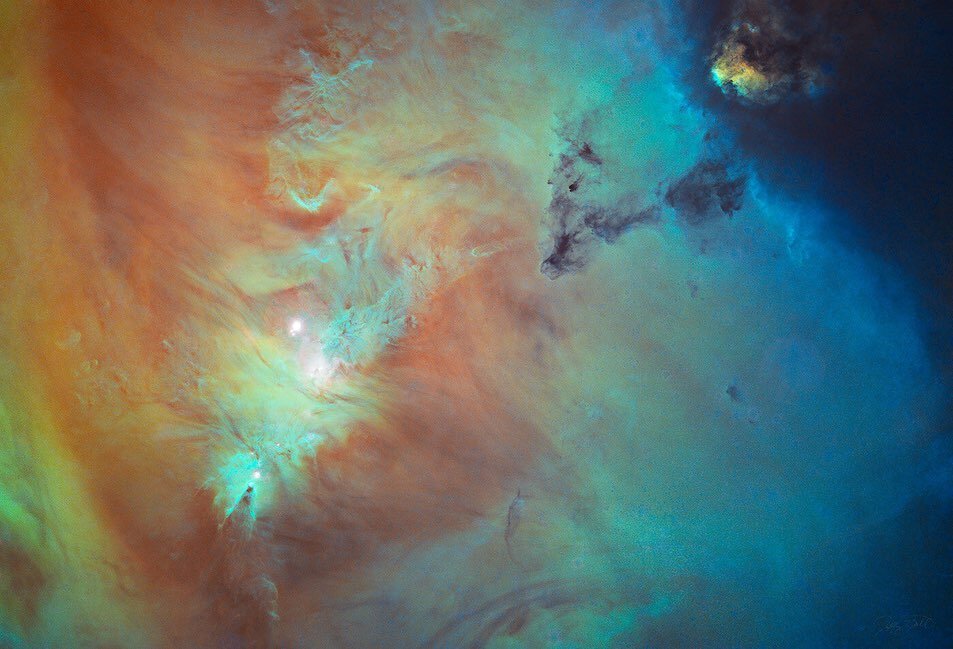
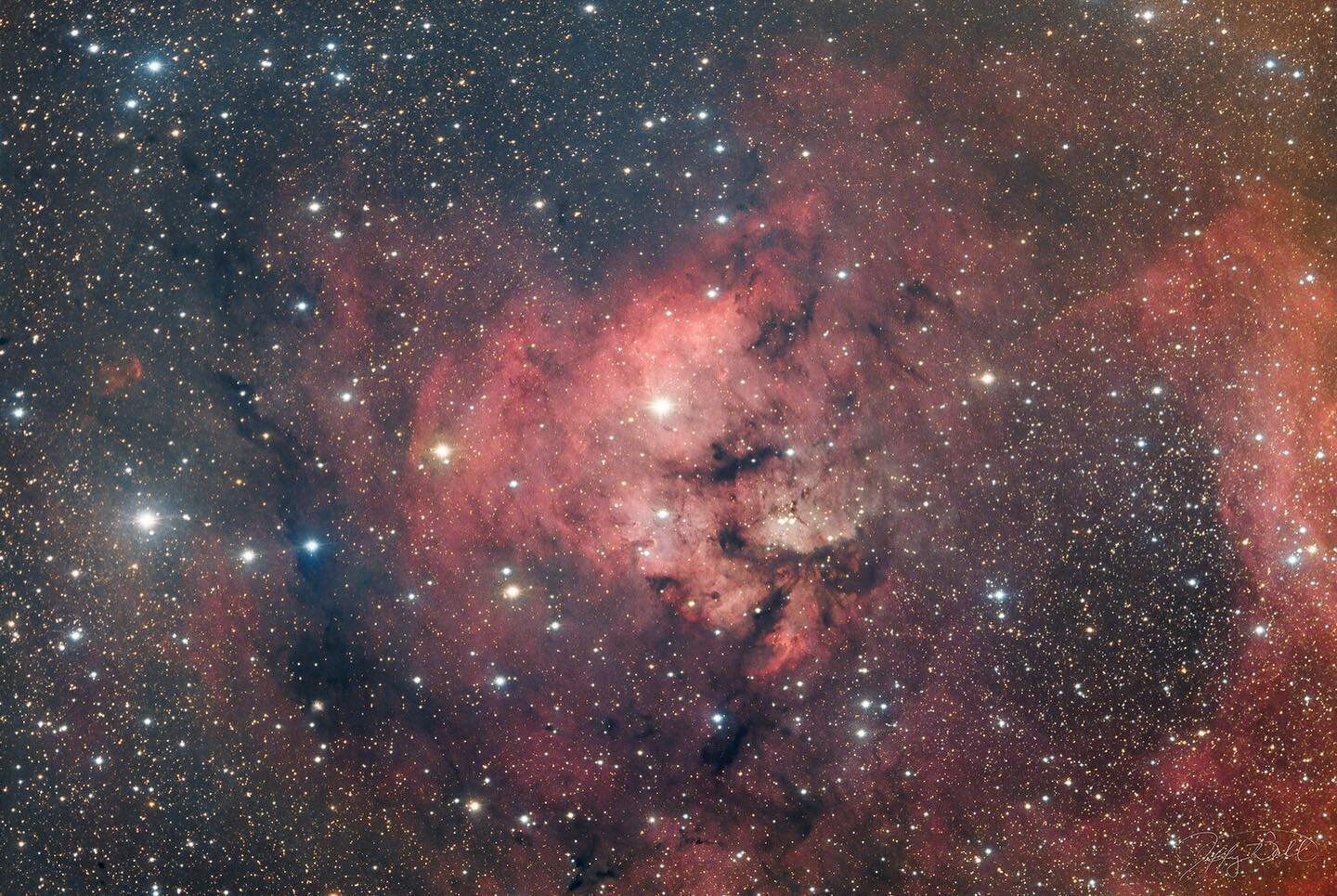
Angels in Monoceros: The Monoceros M2 Complex
The Monoceros R2 molecular complex (often shortened to Mon R2) is a massive giant molecular cloud and one of the nearest active star-forming regions to Earth. It's a dynamic stellar nursery embedded in dense gas and dust, where new stars—particularly massive ones—are actively being born.
Key Facts
Location: Southwestern part of the constellation Monoceros (the Unicorn), near the border with Orion. It's part of the larger Orion-Monoceros cloud complex.
Distance: Approximately 2,400–2,700 light-years (around 830 parsecs).
Size and Structure: The main dense core is relatively compact (a few light-years across), but the overall molecular cloud and associated nebulae span a wide area—reflection nebulae alone stretch up to about 2° in the sky. It's situated well below the galactic plane, which makes it stand out in certain observations.
Age and Activity: Star formation here began roughly 6–10 million years ago. It hosts an OB association (young, hot, massive B- and A-type stars) that illuminates surrounding dust, creating prominent reflection nebulae with bluish hues. There's also significant emission from ionized gas (red glows) and dark nebulae that appear as shadowy silhouettes blocking background light.
Notable Features:
A central hub of massive star formation with embedded clusters, molecular outflows, and HII regions.
Infrared observations (like those from VISTA or 2MASS) penetrate the dust to reveal hidden young stars and protoplanetary disks.
It's a key site for studying early stellar evolution, variability in young stellar objects (YSOs), and the interplay between massive stars and their natal clouds.
The most famous and photogenic part of Mon R2 is the region around NGC 2170 (the Angel Nebula), a striking reflection nebula with wing-like dust structures, glowing blue from scattered starlight, mixed with red emission and dark lanes. Wider views of the complex reveal a richer tapestry of colorful gas, dust filaments, and star clusters.
Credit: GROK 2/28/26
Click on image for larger view.
New Astro Camera: OM-3
Join me for a LIVE conversation about this new astro camera coming to the market. Is this the best option for you? How does it compare to other options? https://www.earthandskyphoto.com Correction: when discussing Bulb mode with Canon, I incorrectly said it had a limit of 30”. I meant to say manual exposure has a max of 30”. In bulb, you need to use a remote control or app for exposure time control. The problem is you can’t set exposure time for stills in the camera menu. I was made aware that Olympus no longer owns the OM system. It is owned by Japanese industrial Partners, a private equity firm. For content on the OM-3 for astrophotography, please see Ben Chapell’s Narrow Band channel. https://youtube.com/@TheNarrowbandChannel?si=GcWY-BM9skG9LPhY
Jeff's Blog
Join me on photography journeys from desert landscapes to deep sky wonders.