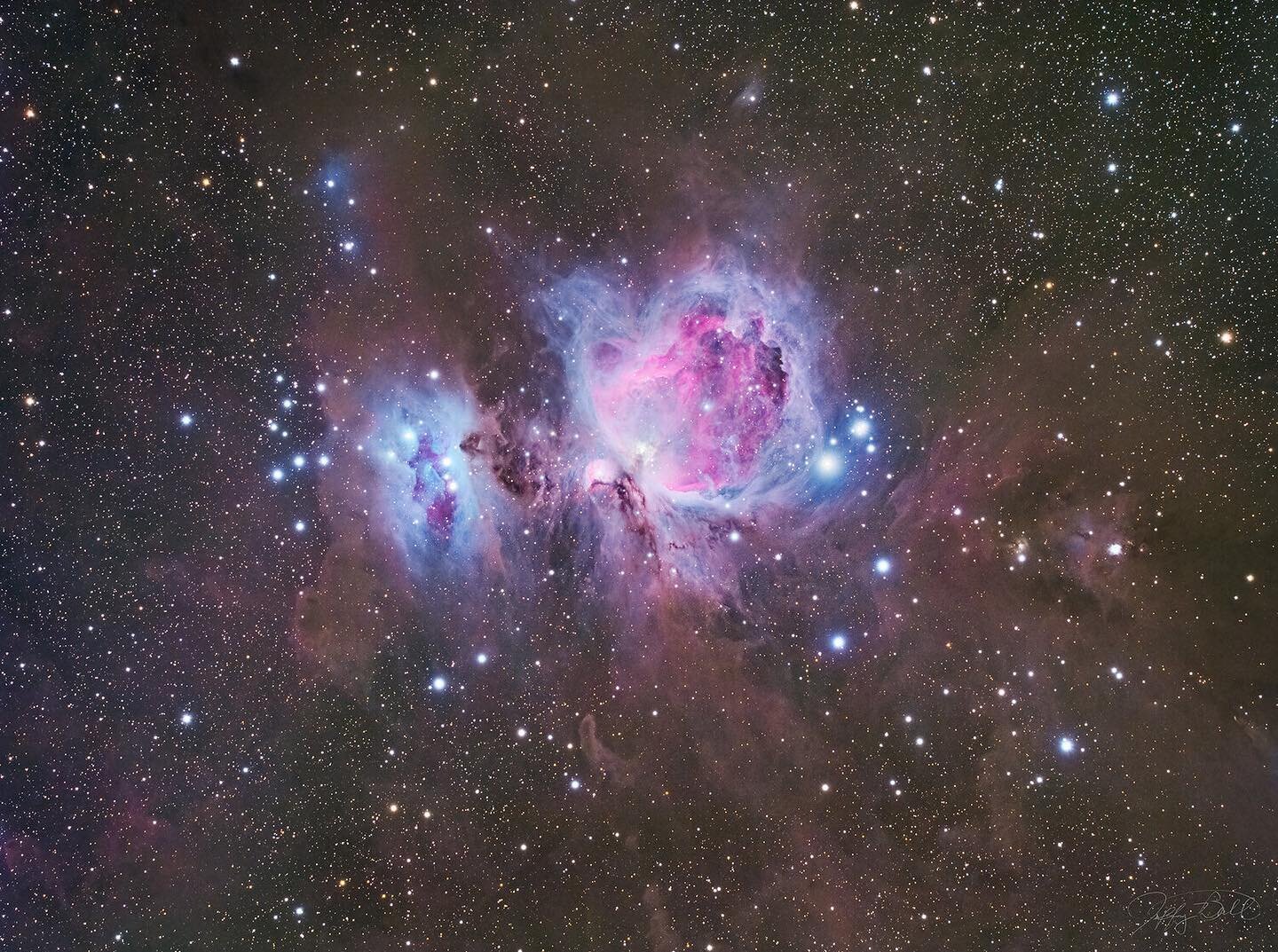
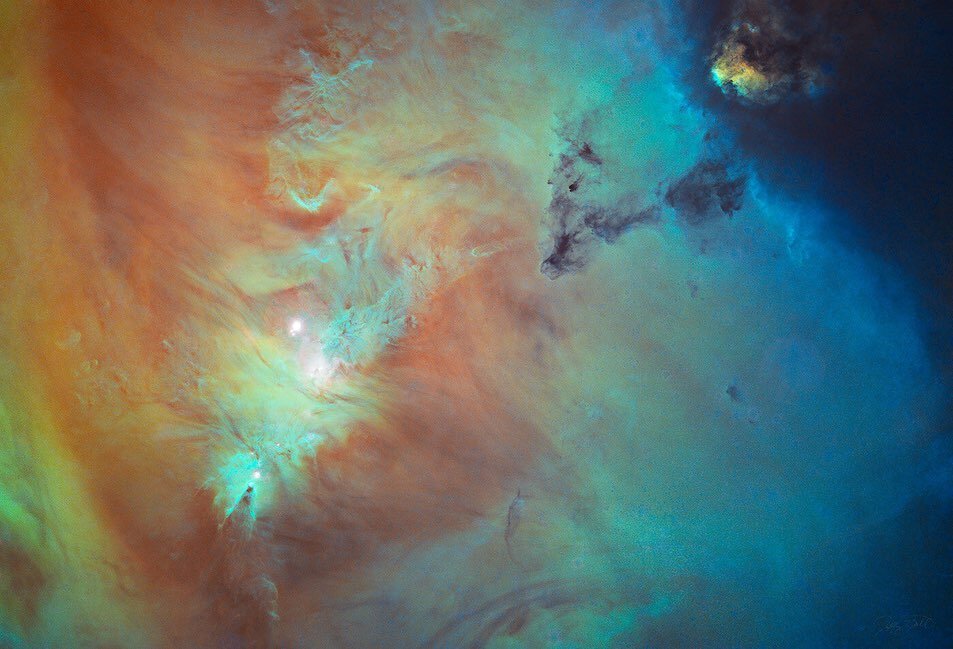
The Herschel 400 Astronomical League Project is underway
It’s not too late to join. We are about 30 objects into the Herschel 400. Hope to get another session in soon. Please subscribe to the YouTube channel so you get notifications on LIVE STREAMS.
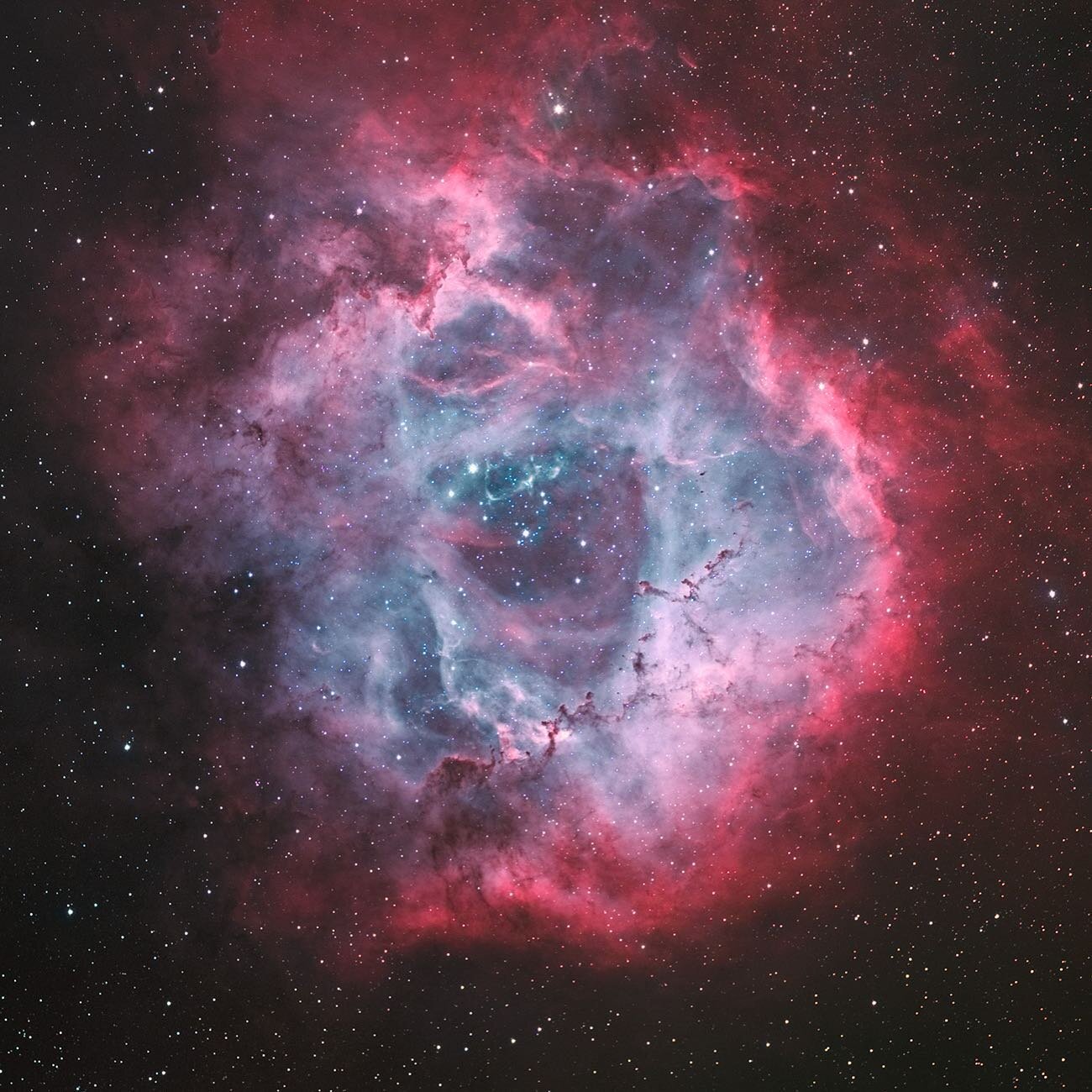
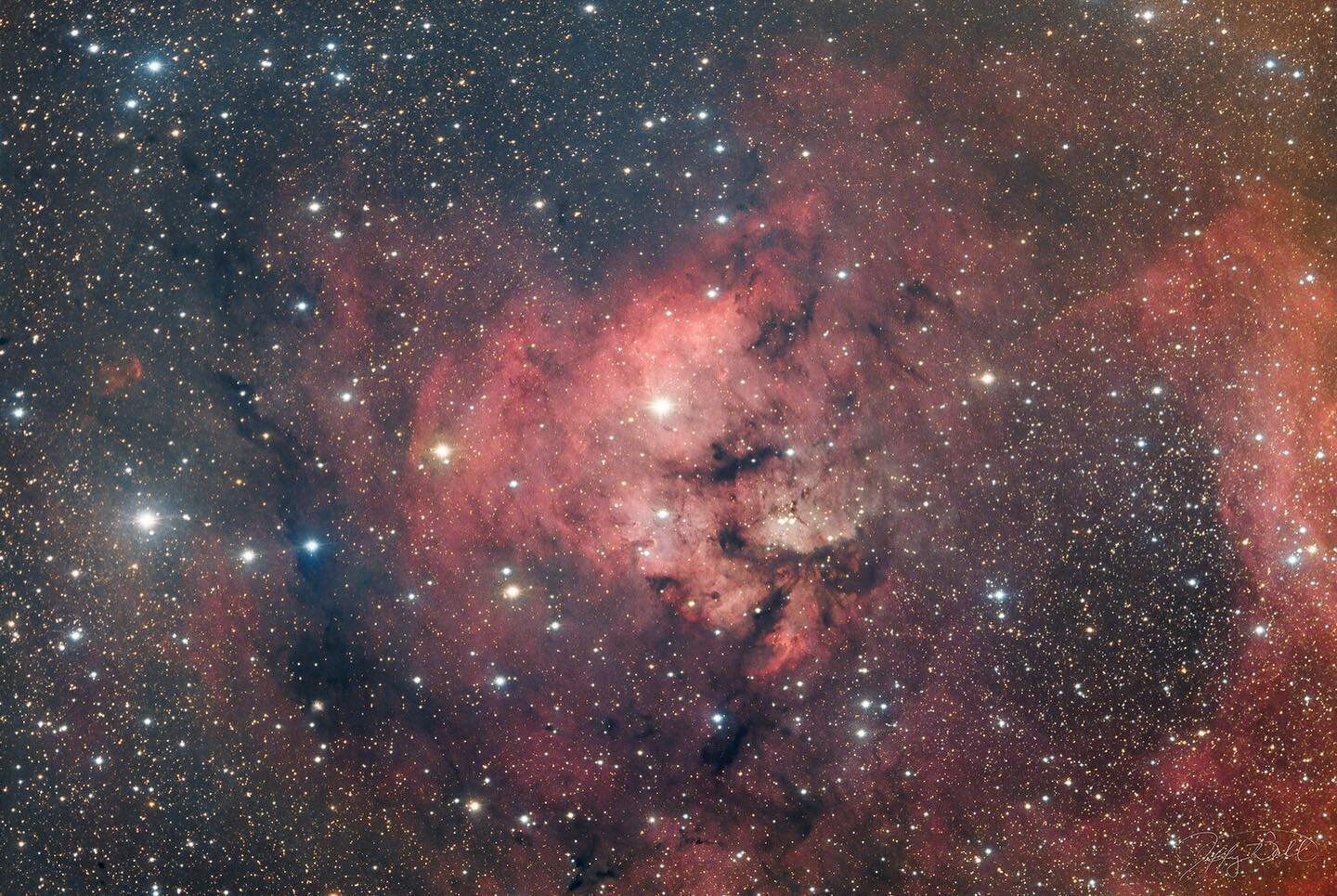
Angels in Monoceros: The Monoceros M2 Complex
The Monoceros R2 molecular complex (often shortened to Mon R2) is a massive giant molecular cloud and one of the nearest active star-forming regions to Earth. It's a dynamic stellar nursery embedded in dense gas and dust, where new stars—particularly massive ones—are actively being born.
Key Facts
Location: Southwestern part of the constellation Monoceros (the Unicorn), near the border with Orion. It's part of the larger Orion-Monoceros cloud complex.
Distance: Approximately 2,400–2,700 light-years (around 830 parsecs).
Size and Structure: The main dense core is relatively compact (a few light-years across), but the overall molecular cloud and associated nebulae span a wide area—reflection nebulae alone stretch up to about 2° in the sky. It's situated well below the galactic plane, which makes it stand out in certain observations.
Age and Activity: Star formation here began roughly 6–10 million years ago. It hosts an OB association (young, hot, massive B- and A-type stars) that illuminates surrounding dust, creating prominent reflection nebulae with bluish hues. There's also significant emission from ionized gas (red glows) and dark nebulae that appear as shadowy silhouettes blocking background light.
Notable Features:
A central hub of massive star formation with embedded clusters, molecular outflows, and HII regions.
Infrared observations (like those from VISTA or 2MASS) penetrate the dust to reveal hidden young stars and protoplanetary disks.
It's a key site for studying early stellar evolution, variability in young stellar objects (YSOs), and the interplay between massive stars and their natal clouds.
The most famous and photogenic part of Mon R2 is the region around NGC 2170 (the Angel Nebula), a striking reflection nebula with wing-like dust structures, glowing blue from scattered starlight, mixed with red emission and dark lanes. Wider views of the complex reveal a richer tapestry of colorful gas, dust filaments, and star clusters.
Credit: GROK 2/28/26
Click on image for larger view.
New Astro Camera: OM-3
Join me for a LIVE conversation about this new astro camera coming to the market. Is this the best option for you? How does it compare to other options? https://www.earthandskyphoto.com Correction: when discussing Bulb mode with Canon, I incorrectly said it had a limit of 30”. I meant to say manual exposure has a max of 30”. In bulb, you need to use a remote control or app for exposure time control. The problem is you can’t set exposure time for stills in the camera menu. I was made aware that Olympus no longer owns the OM system. It is owned by Japanese industrial Partners, a private equity firm. For content on the OM-3 for astrophotography, please see Ben Chapell’s Narrow Band channel. https://youtube.com/@TheNarrowbandChannel?si=GcWY-BM9skG9LPhY
Eta Carina from Winter Star Party
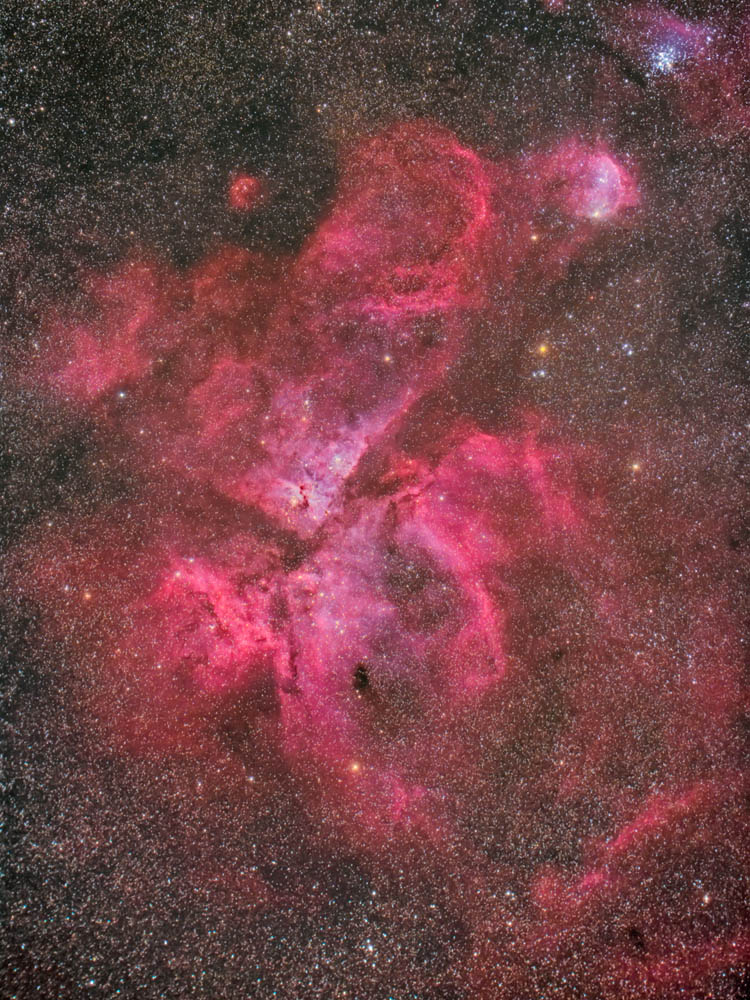 The Eta Carinae NebulaA rare opportunity...to image Eta Carina from the northern hemisphere. I have been to WSP on three occasions and finally had a night for the ages. The transparency on the night of February 11 was incredible. I typically don't hold out much hope for transparent skies down to the horizon where most of the time ocean haze and persistent low clouds tend to hang out. On this night after gathering some very good data on the Witch Head Nebula, we started to get excited about the possibilities of imaging Eta. Our group of imagers began monitoring the sky quality on the ocean horizon early in the evening and we were seeing stars lower and lower as time passed.
Eta climbs only a meager 8 degrees or so above the ocean from 24 degrees north latitude on Big Pine Key. We were easily seeing stars at this elevation and even lower, nearly all the way to the ocean horizon. After completing the data acquisition on the Witch Head nebula, I began to prep for imaging Eta.
Just to give you and idea about how low this object is, most of the time our telescopes are pointing nearly straight up into the darkness, but on this night they were pointed nearly horizontal toward one of the largest nebula in the Milky Way Galaxy.
My first glimpse of the camera LCD screen showed the incredible nebulosity complex and I began to get very excited about the opportunity this night was giving to us. A total of 100 minutes of usable data was acquired and here is the final presentation. I will have a future blog on the details around the acquisition of the image. I hope you enjoy the image and that you get a chance to take in the Eta Carinae nebula for yourself through a large telescope at some point in your life.
Please visit the Color Astronomical Gallery and click on the image for a larger presentation. You may also purchase a fine art print of Eta Carinae by either emailing me, phoning, or simply using the online purchase option.
ATIK Camera's Warren Keller discusses CCD offerings
http://www.youtube.com/watch?v=E1WwhUTMD1EWarren Keller of ATIK camera from Jeff Ball on Vimeo.
U.S. representative Warren Keller discusses ATIK CCD cameras now available in the U.S.
You can find ATIK USA at the link below
http://www.atik-usa.com/
A very special THANKS to Tom Kennedy for technical assistance on video production.
Al Nagler discusses his astrophotography endeavors
Al Nagler discusses his astrophotography endeavors from Jeff Ball on Vimeo.
Noted telescope designer Al Nagler discusses his early efforts at astrophotography and current telescope designs aimed at improving imaging performance of his telescopes. A wonderful few minutes spent with one of the industry's icons and a terrific ambassador for the amateur astronomy community. I am sure you will enjoy the discussion and learn a thing or two.
This video is part of a project I am putting together, but felt that Mr. Nagler's presentation stood on its own from an entertainment and information point of view.
I have had an opportunity to image with Televue instruments over the years including the TV85 and TV101. These instruments are capable of taking wonderful astrophotos. The TV101 and TV127 IS systems are particularly noted for their astrophotographic performance. I encourage you to consider Televue for your astrophotography needs, not to mention those unbelievable eyepieces for the visual astronomer!
A very special THANK YOU to Tom Kennedy for his technical assistance on video production!!
Thanks and clear skies.
A new tool for astrophotography enhancement
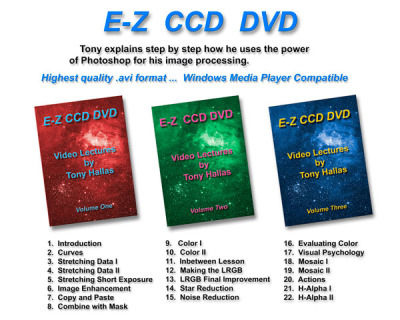 EZ CCD DVD by Tony Hallas is a new tool for the astrophotographer to improve their image enhancement skills. I just completed viewing the 3 DVD set and here are the answers to your questions:
- Is it worth the $68? Yes. You have to remember, as much as I have studied Photoshop and processing, I still approach the subject as "unknowable." I always learn something from every course I digest. What I particularly like about this DVD series is that you are basically sitting at Tony's side as he works through M81 processing from post-reduction to final print. You work through stretching of luminance and application of RGB with the utmost attention to detail. This is the definition of Fine Art Photography.
- Will it make my images better? Yes. There were moments when I had the DVD running on my laptop with my M31 open in Photoshop and applied the current lesson to the image. The image was improved by at least 20% through these new approaches. In particular, application of the spunge and high pass filters were most useful for this image.
- Will I learn something? Yes. I have studied with many of the country's top landscape photographers and image enhancement and compositional consideration were a part of those instructions. I still learned many new techniques and more importantly how to apply them at my artistic taste.
- Who is this for? Are your frustrated with your image processing? Do you not know how to effectively use masks and filters to enhance selected parts of your image? Do you have a pretty good understanding of Photoshop, but want to go a bit deeper into the water? Then this DVD set is for you.
The DVDs contain video files of Tony lecturing during his workflow in addition to some lectures on color, visual psychology, mosaic construction, and hydrogen alpha enhancement. The DVDs are focused on enhancing 16 bit fit files converted to TIFF, which is a bit different from my current workflow with RAW converted DSLR images. So my stretching of TIFF data is a bit different than what Tony presents, but after the lecture on stretching, all other techniques are certainly viable for any astrophotographer regardless of how the data was captured.
I had to chuckle on his "green gun" technique as I recall when he introduced that to the old film astrophoto list many years ago. It is still a very viable technique and one that every astrophotographer should be aware of.
What I like most about Tony's presentation is that he is first and foremost an artist with a vision. You may or may not find his final art product to your liking, that is the nature of the beast, but what he does do is share with you what is possible and encourages you to explore those possibilities that match your own artistic voice. That is what is really important, developing your own artistic eye. While it is important to be keenly aware of the enhancement tools at your discretion, ultimately it is your ability as an artist to visually interpret the data and present it in a way that meets your artistic vision and pleases your intended audience.
That is exactly what I like to focus on when working with imagers, finding their own artistic vision and reconciling their work to meet that vision. If you find yourself not satisfied with your work, you know that something is just not right, give me a call and we can discuss some of the ways to find meet your vision through your image optimization approach.
You can purchase the DVD set directly from Tony here or from Astro-Physics here.
Sunrise Moon from West Summerland Key, FL
 Sunrise Moon from Florida keysAfter a spectacular night of astrophotography, I was treated to this intense display of light at sunrise. I was totally fatigued by the night's imaging, but this scene energized me so much that I had to work the scene. The Moon and rocks provided the necessary compositional elements to complete balance and a sense of scale to the image that is dominated by the intense horizon light. The Florida Keys offer many opportunities for amazing light and I hope to return often in order to capture those moments and bring them back to you.
The image is the first of the Florida collection and may be viewed in larger format by visiting that gallery. Many more images to come to the Florida gallery.
This image may be purchased by simply visiting the "Purchase Fine Art Prints" menu option, selecting your print size, and then typing "Sunrise Moon" as the image title of the print.
Jeff's Blog
Join me on photography journeys from desert landscapes to deep sky wonders.