Yes, Canon to offer video firmware upgrade
I purchased the Canon 5D MarkII about one month ago. My primary purpose was to use it in my landscape photography, but I was really drawn to the HD video capability. The one downside to the camera was the lack of manual control in video mode. The user was limited to simply letting the camera do everything automatically in video mode. Today Canon announced the availability in early June of a new firmware upgrade that will now make available to the user manual controls in video mode. The user will have control over aperture, ISO, and shutter speed. This is a tremendous announcement and I am very excited about this new opportunity with the camera. Please stay tuned for further developments and reports on the camera and video opportunities it presents.
Kirk Rogers featured on Maine TV show
Please take a moment to visit my good friend and wonderful photographer Kirk Rogers' website for a video clip that presents Kirk's astrophotography to the viewers in Maine, U.S.A. The clip is approximately 5 minutes long and shows Kirk's equipment, images, and the observatory of Rob Burgess where Kirk's gear is housed. Congratulations to Kirk on the feature and I hope you enjoy the show.
Bill Green's Maine featuring the Astrophotography of Kirk Rogers
The only mount I will ever need

You may never have heard of the Astro-Physics Mach1 GTO mount before, but it is a beautiful piece of equipment that should prove to be the only mount I will ever need. I have had experience with numerous astrophotography mounts over the years including the Losmandy GM8, G11, and Titan as well as the Astro-Physics 600E QMD, 600E GTO, 900 GTO, and 1200 GTO. The Mach1 offers the astro-imager the most rigid and stable mount in a very portable package. The mount is capable of being used in a fixed location observatory or as a portable mount for remote high mountain imaging from the darkest skies possible.
Any mount this size eventually has a limitation as to how big of a scope it can carry. But my astro-imaging compositions require relatively small instruments and I don't believe my scope requirements will ever outgrow the capabilities of the Mach1.
I just received the mount last week and have begun familiarizing myself with the functions and performance. My plan is to image with it next new moon and I hope to have results for you a few days after that.
So until then...clear skies to you all and may you have wonderful photographic opportunities.
A Night at the Winter Star Party
While at the Winter Star Party in February, I imaged with multiple cameras through the night. The primary camera was on the telescope with a secondary wide angle camera on the G11 mount and a third camera for night landscape from a tripod. One of the techniques I wanted to experiment with was a time-lapse of our imaging area with a star field for the entire night. My first results of this can be found on my Vimeo page linked below. A higher quality video is available for download from the Vimeo webpage for Vimeo members. Registration is simple and takes only a few seconds.
I really hope to explore this technique more fully over the coming months and to incorporate the results in a more comprehensive artistic output. I hope you enjoy the video and there is more information on the Vimeo webpage. I am also experimenting with the video capabilities of the 5D Mark II and will update the blog with results from that soon. Thanks and take care...
The Globular Cluster of Stars

What contains over 5 million solar masses, has about the same mass of the smallest whole galaxies, and is the second brightest globular cluster in the local group of galaxies? The globular cluster known as Omega Centauri or NGC 5139 is the answer. This image was captured along the beaches of the Florida Keys during the Winter Star Party in February. (Please click on the image for a larger presentation.)
The image was taken with a relatively short focal length telescope at 400mm. This view is very close to approximating the view through a nice pair of astronomical binoculars. That is my favorite way to view this object as the sparkling cluster shimmers against a backdrop of dark space. For more information on the object please see
http://messier.obspm.fr/xtra/ngc/n5139.html.
The image information is: captured with a modified Canon 450D, 11 frames of 3.5 minutes each at ISO 1600 on a TMB 92mm telescope at f5. The mount used was an Astro-Physics 400GOTO. All processing in Adobe Lightroom and Photoshop. Please contact me if you have any further questions and I hope you enjoy the image.
If you are ever at a southern location in northern hemisphere winter, please do yourself a favor and gaze through a pair of binoculars at this heavenly site.
The Herschel 400 Astronomical League Project is underway
It’s not too late to join. We are about 30 objects into the Herschel 400. Hope to get another session in soon. Please subscribe to the YouTube channel so you get notifications on LIVE STREAMS.
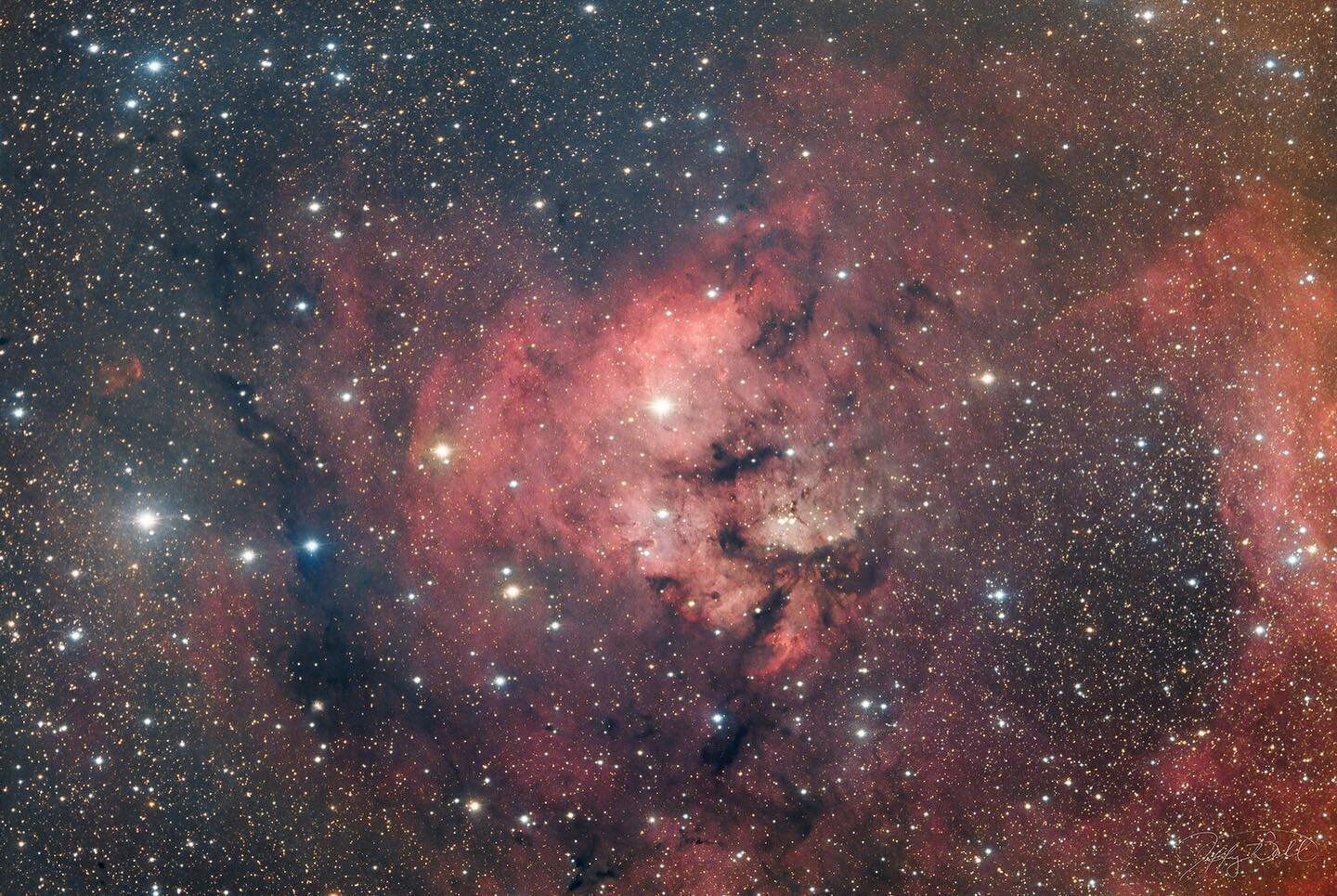
Angels in Monoceros: The Monoceros M2 Complex
The Monoceros R2 molecular complex (often shortened to Mon R2) is a massive giant molecular cloud and one of the nearest active star-forming regions to Earth. It's a dynamic stellar nursery embedded in dense gas and dust, where new stars—particularly massive ones—are actively being born.
Key Facts
Location: Southwestern part of the constellation Monoceros (the Unicorn), near the border with Orion. It's part of the larger Orion-Monoceros cloud complex.
Distance: Approximately 2,400–2,700 light-years (around 830 parsecs).
Size and Structure: The main dense core is relatively compact (a few light-years across), but the overall molecular cloud and associated nebulae span a wide area—reflection nebulae alone stretch up to about 2° in the sky. It's situated well below the galactic plane, which makes it stand out in certain observations.
Age and Activity: Star formation here began roughly 6–10 million years ago. It hosts an OB association (young, hot, massive B- and A-type stars) that illuminates surrounding dust, creating prominent reflection nebulae with bluish hues. There's also significant emission from ionized gas (red glows) and dark nebulae that appear as shadowy silhouettes blocking background light.
Notable Features:
A central hub of massive star formation with embedded clusters, molecular outflows, and HII regions.
Infrared observations (like those from VISTA or 2MASS) penetrate the dust to reveal hidden young stars and protoplanetary disks.
It's a key site for studying early stellar evolution, variability in young stellar objects (YSOs), and the interplay between massive stars and their natal clouds.
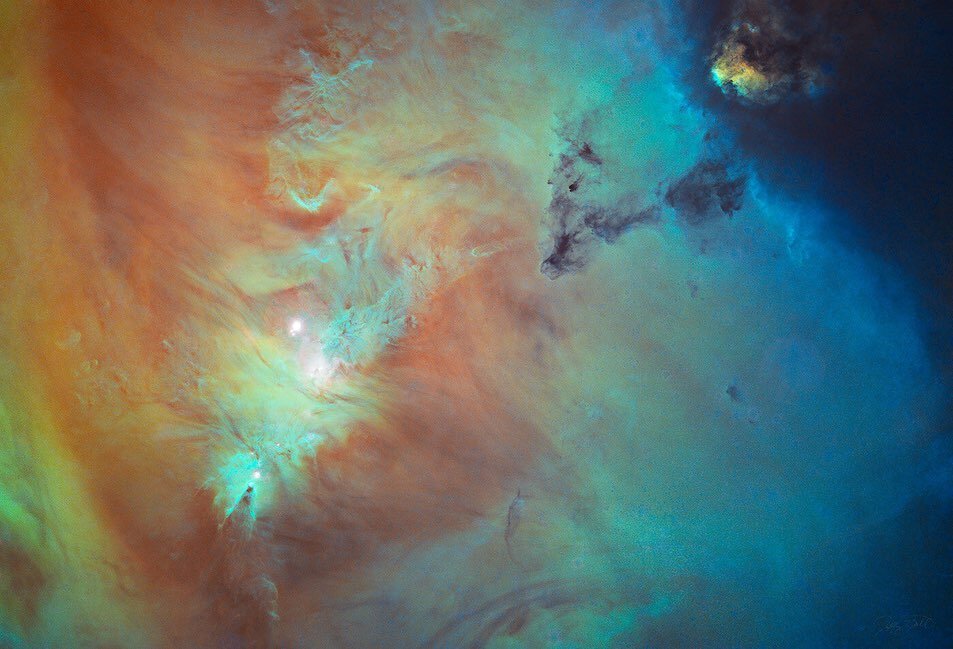
The most famous and photogenic part of Mon R2 is the region around NGC 2170 (the Angel Nebula), a striking reflection nebula with wing-like dust structures, glowing blue from scattered starlight, mixed with red emission and dark lanes. Wider views of the complex reveal a richer tapestry of colorful gas, dust filaments, and star clusters.
Credit: GROK 2/28/26
Click on image for larger view.
New Astro Camera: OM-3
Join me for a LIVE conversation about this new astro camera coming to the market. Is this the best option for you? How does it compare to other options? https://www.earthandskyphoto.com Correction: when discussing Bulb mode with Canon, I incorrectly said it had a limit of 30”. I meant to say manual exposure has a max of 30”. In bulb, you need to use a remote control or app for exposure time control. The problem is you can’t set exposure time for stills in the camera menu. I was made aware that Olympus no longer owns the OM system. It is owned by Japanese industrial Partners, a private equity firm. For content on the OM-3 for astrophotography, please see Ben Chapell’s Narrow Band channel. https://youtube.com/@TheNarrowbandChannel?si=GcWY-BM9skG9LPhY
Jeff's Blog
Join me on photography journeys from desert landscapes to deep sky wonders.