Recommended-Brooks Jensen Podcasts
On vacation in Myrtle Beach with golfing, beach, and photography. My photography location will be Brookgreen Gardens just south of Murrell's Inlet. I hope to visit there tomorrow. But I had a chance to catch up on my favorite podcast from Brooks Jensen and I wanted to invite you to visit his podcasts as well. Brooks provides valuable insight into photography today from all angles including technical advancements and artistic presentations. I always glean something of value from his podcasts and if you are a student of photography like me, I think you will, too. Please follow the link above for his website and links to his podcasts.
First light...sorta
Last night was my first night to setup the Mach1 and Tak FSQ 85 for an imaging run. The clear sky clock looked wonderful and the skies were pristine during the evening. I setup in the backyard since I was hoping to have two straight nights of imaging and wanted to work out the kinks in the new gear. Setup went very smoothly and the equipment worked flawlessly. Unfortunately, a persistent puffy partly cloudy sky never relinquished. So no images were taken, but the gear checked out nicely. I was able to do a lot; monitored the drives performance via the autoguider, perform calibration for autoguiding, refined technique for using the laptop for focus with and without an h-alpha filter in place in the camera, and tested all of the new USB cords and hubs in use. So it was a successful night and I am ready to tonight! Clear skies!
Horsehead: A refinement in processing

With some time to process, I have dug into the Horsehead and astronomical workflow to find the best approach. My main efforts are built around noise reduction and determining at what point to apply noise reduction software. The choices are to apply in RAW conversion in LR or to wait and use a PS plugin or 3rd party independent software. I have previously used Noise Ninja after the image is nearly complete, but was recently introduced to Noiseware. I am using the Pro version of Noiseware as a PS plugin. The main advantage to Noiseware is that I can use it in my normal workflow within PS and can use color profiles effectively. Noise Ninja did not work well with color profiles as an independent app. Noiseware has numerous controls, too numerous to mention here, for controlling how and where the noise reduction is to be applied. My thoughts are that it might be best to add some noise reduction in the RAW file in LR and then utilize Noiseware late in the processing stage. This particular image had no noise reduction applied in LR. I am going to rework the Horsehead image with that approach and will report back with results. One thing I love about astronomical photographs is that they are so difficult to work with that it makes landscape optimization so much easier. Take care and check out Noiseware if you get a chance on some really noisy images.
One other change in workflow with this image involved applying a flat field from the RAW camera files to the image in PS. This worked very well and is now a part of my workflow. I found no advantage to applying dark frames to the image. I believe dark frames are largely a waste with the Canon 450D and that simply increasing the amount of signal is the best way to maximize the signal to noise ratio.
Apple's other update

While all iPhone uses were upgrading to 3.0, and it is a nice upgrade, Apple also made some very nice enhancements to their Safari web browser. I hadn't really seen anything about this upgrade and was pleasantly surprised to see some new features. Two new features that I love are tied to the "new tab" request. Upon forming a new tab the surfer is presented with a screen of previously visited top websites by you in a portfolio presentation of images. I love this and it makes browsing my favorite sites even easier than pulling down a bookmark. In addition, the user can browse or search for previously searched webpages. This webpage looks just like the iTunes page of album art search for movies or music. These two features have not only made Safari my preferred browser on the MAC, but I have now upgraded to the Safari 4.0 on my Windows machines and I love it. Check it out if you haven't already, especially if you are a tab browser.
A bit of an update: There is a "Top Sites" icon at the top left of the browser that pops up the top 12 sites you visit. This actually may replace tabbed browsing. Finally, Apple has applied their creativity and genius in user interface to the web browser!!!
Cinderella's Ice Castle

In the fall of 2008 our family visited Disney World for my son's senior high school trip. For a camera, we had my wife's convenient Canon 400D. The stock 18-55mm lens was on the camera which limited compositions as well as perspective control options. Long telephoto lenses can help minimize distortions when photographing from a distance. The ice decorations on the castle were quite stunning and so I worked on a couple of different compositions, mainly for practice, as I knew there would be some different techniques involved. On this particular image, I combined 4 frames vertically in Photoshop to give extra image area so that I could then perform a perspective correction. This composition poses several challenges including a huge dynamic range, hand-held image capture at ISO 1600 and 1/8 of a second, large crowds of people, and a tired tourist at the shutter. So this is the final presentation after RAW conversion in LR, vertical stitching and perspective control in PS3. I hope you enjoy the image and I encourage you to visit Disney World during the holiday season for some special treats like Cinderalla's Ice Castle.
The Herschel 400 Astronomical League Project is underway
It’s not too late to join. We are about 30 objects into the Herschel 400. Hope to get another session in soon. Please subscribe to the YouTube channel so you get notifications on LIVE STREAMS.
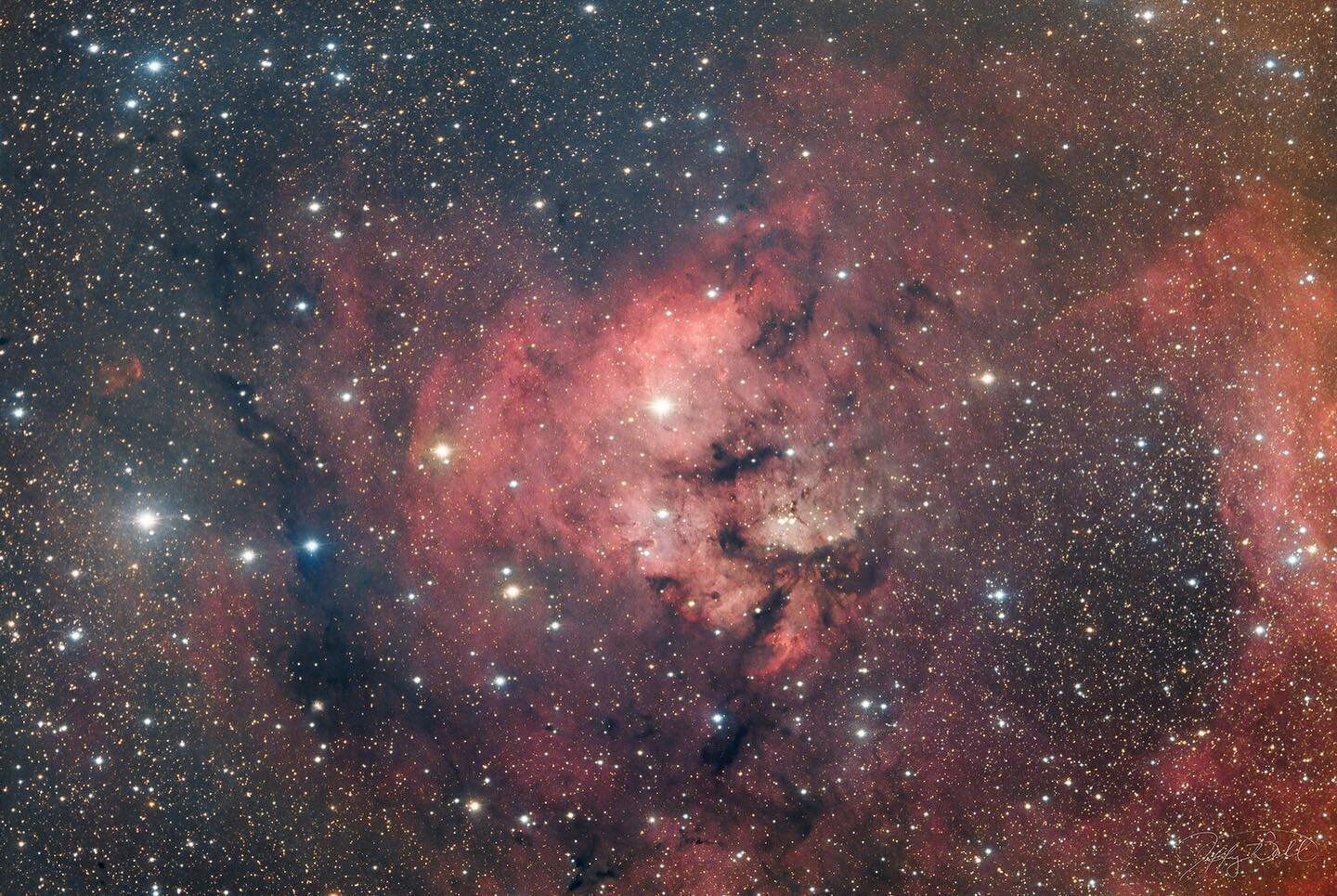
Angels in Monoceros: The Monoceros M2 Complex
The Monoceros R2 molecular complex (often shortened to Mon R2) is a massive giant molecular cloud and one of the nearest active star-forming regions to Earth. It's a dynamic stellar nursery embedded in dense gas and dust, where new stars—particularly massive ones—are actively being born.
Key Facts
Location: Southwestern part of the constellation Monoceros (the Unicorn), near the border with Orion. It's part of the larger Orion-Monoceros cloud complex.
Distance: Approximately 2,400–2,700 light-years (around 830 parsecs).
Size and Structure: The main dense core is relatively compact (a few light-years across), but the overall molecular cloud and associated nebulae span a wide area—reflection nebulae alone stretch up to about 2° in the sky. It's situated well below the galactic plane, which makes it stand out in certain observations.
Age and Activity: Star formation here began roughly 6–10 million years ago. It hosts an OB association (young, hot, massive B- and A-type stars) that illuminates surrounding dust, creating prominent reflection nebulae with bluish hues. There's also significant emission from ionized gas (red glows) and dark nebulae that appear as shadowy silhouettes blocking background light.
Notable Features:
A central hub of massive star formation with embedded clusters, molecular outflows, and HII regions.
Infrared observations (like those from VISTA or 2MASS) penetrate the dust to reveal hidden young stars and protoplanetary disks.
It's a key site for studying early stellar evolution, variability in young stellar objects (YSOs), and the interplay between massive stars and their natal clouds.
The most famous and photogenic part of Mon R2 is the region around NGC 2170 (the Angel Nebula), a striking reflection nebula with wing-like dust structures, glowing blue from scattered starlight, mixed with red emission and dark lanes. Wider views of the complex reveal a richer tapestry of colorful gas, dust filaments, and star clusters.
Credit: GROK 2/28/26
Click on image for larger view.
New Astro Camera: OM-3
Join me for a LIVE conversation about this new astro camera coming to the market. Is this the best option for you? How does it compare to other options? https://www.earthandskyphoto.com Correction: when discussing Bulb mode with Canon, I incorrectly said it had a limit of 30”. I meant to say manual exposure has a max of 30”. In bulb, you need to use a remote control or app for exposure time control. The problem is you can’t set exposure time for stills in the camera menu. I was made aware that Olympus no longer owns the OM system. It is owned by Japanese industrial Partners, a private equity firm. For content on the OM-3 for astrophotography, please see Ben Chapell’s Narrow Band channel. https://youtube.com/@TheNarrowbandChannel?si=GcWY-BM9skG9LPhY
Jeff's Blog
Join me on photography journeys from desert landscapes to deep sky wonders.