Comet Lulin video
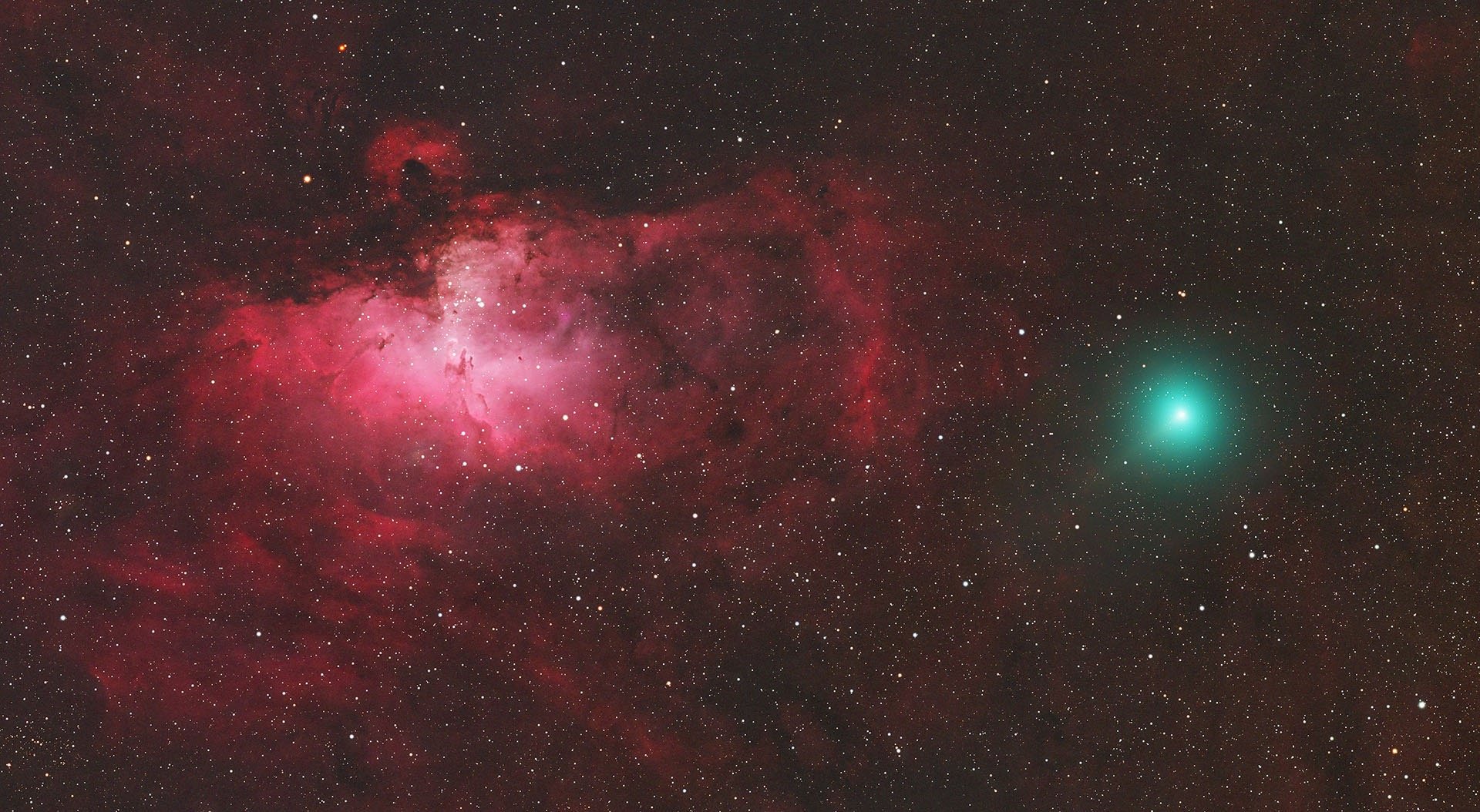
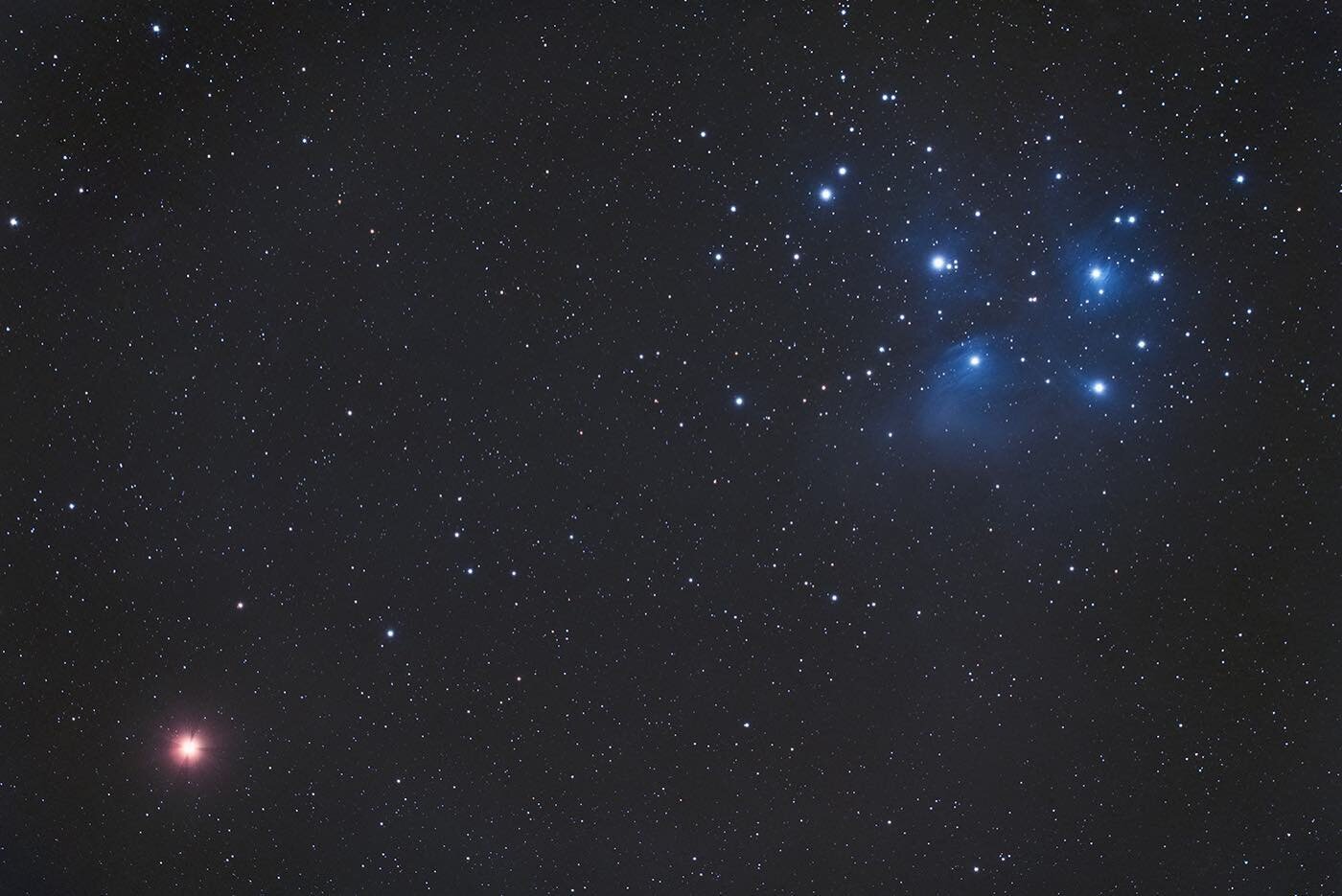
Comet Lulin graced North American skies in the winter of 2009. Fortunately, the closest approach was during the Winter Star Party in February. Comet Lulin proved to be much more interesting than I had previously been inclined to believe. The comet brightened dramatically over the week of February 24 and sported a beautiful ion blue tail. I slewed to the comet with the scope and began my initial exposures and was surprised by the views on the LCD screen. The blue ion tail was crumpled and extending away from the comet nucleus in a beautiful fashion. So this object became the main target object during the 2-4 a.m. imaging window on most nights.
This video is a time-lapse sequence of 9 3.5 minute exposures taken on February 21, 2009 from the Winter Star Party in the Florida Keys. Each image was optimized in Adobe Light Room and the video was compiled with Windows Movie Maker. The video loops several times so that the viewer can pick up the subtle changes in the blue ion tail. Geostationary satellites are common in this area of sky and pass through the field as through they were moving airplanes, but in fact it is the telescope and camera moving to compensate for the Earth's rotation.
An Orion experiment

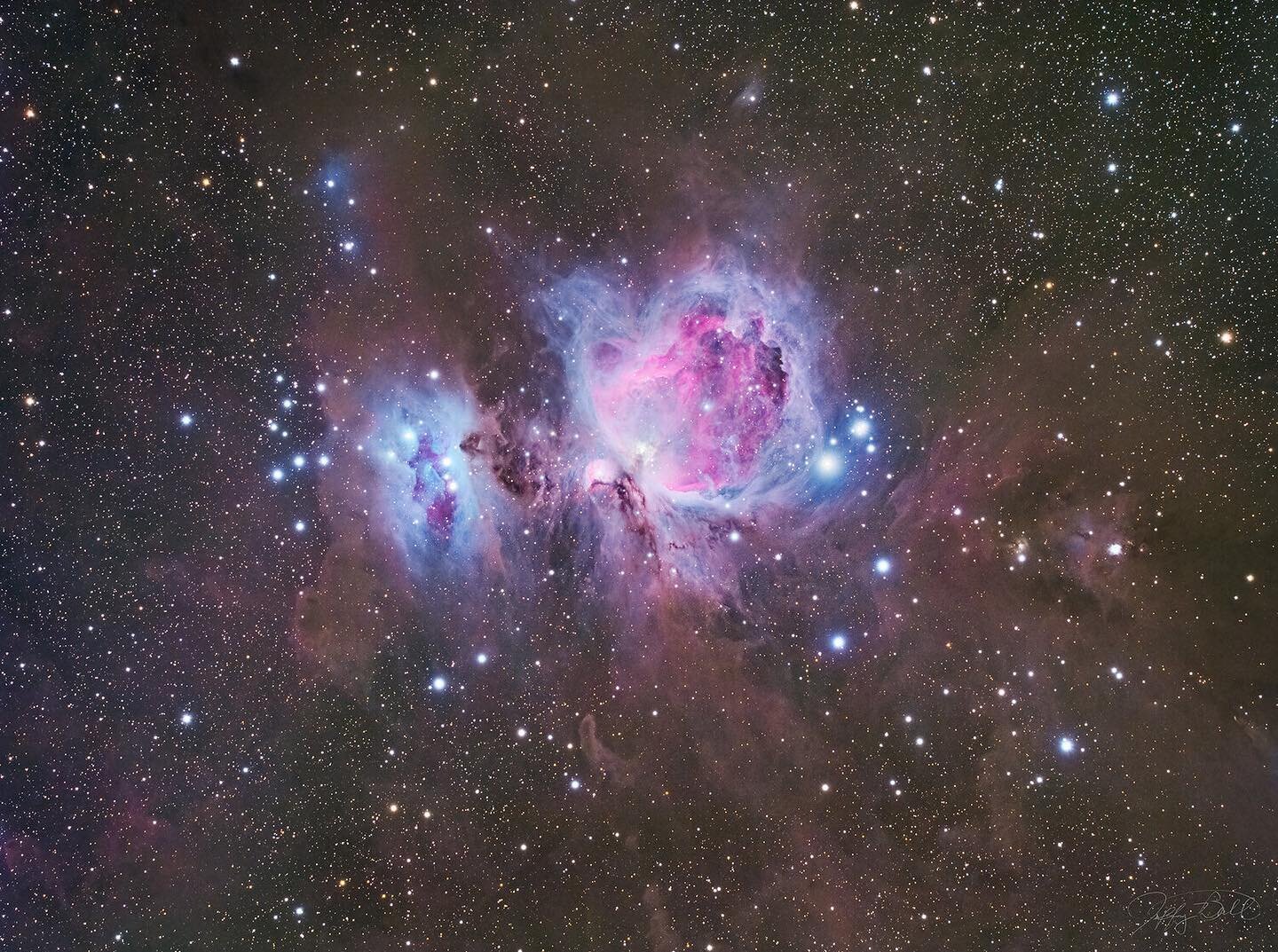
Now this is simply crazy. I had some Orion Nebula data from WSP that I basically captured on a whim. So in reviewing the data in Light Room I wanted to see just what the new techniques could bring out of this data. Let me state up front that this is simply not enough data to get what I eventually want out of this image. But, it is a great exercise in seeing exactly what the technique can do with very limited amounts of data. I selected 11 of the best frames captured on the Canon 450D and TMB 92SS combination. I optimized each image in LR 2.2 and exported to tiff. I used Images Plus and Sigma clip for the alignment and combination and then processed as normal in PS3. Now one other major error on my part, not that the clouds at WSP had anything to do with it, was that I failed to capture shorter exposures to compensate for the over-exposed core of M42. So I did plug in some old data from other instruments for the core of M42 in this image. There is a fair amount of noise reduction via Noise Ninja applied to the shadow areas. So for only 40 minutes of data with a lowly DSLR, I am very happy with the potential to really capture the Orion Nebula area as I hope next year. My expectations are that two hours of data at ISO 800 will be wonderful data to work with and accomplish my imaging goals. Please drop me a line if you have any questions or comments and I hope you enjoy the image.
Rosette Nebula from Winter Star Party

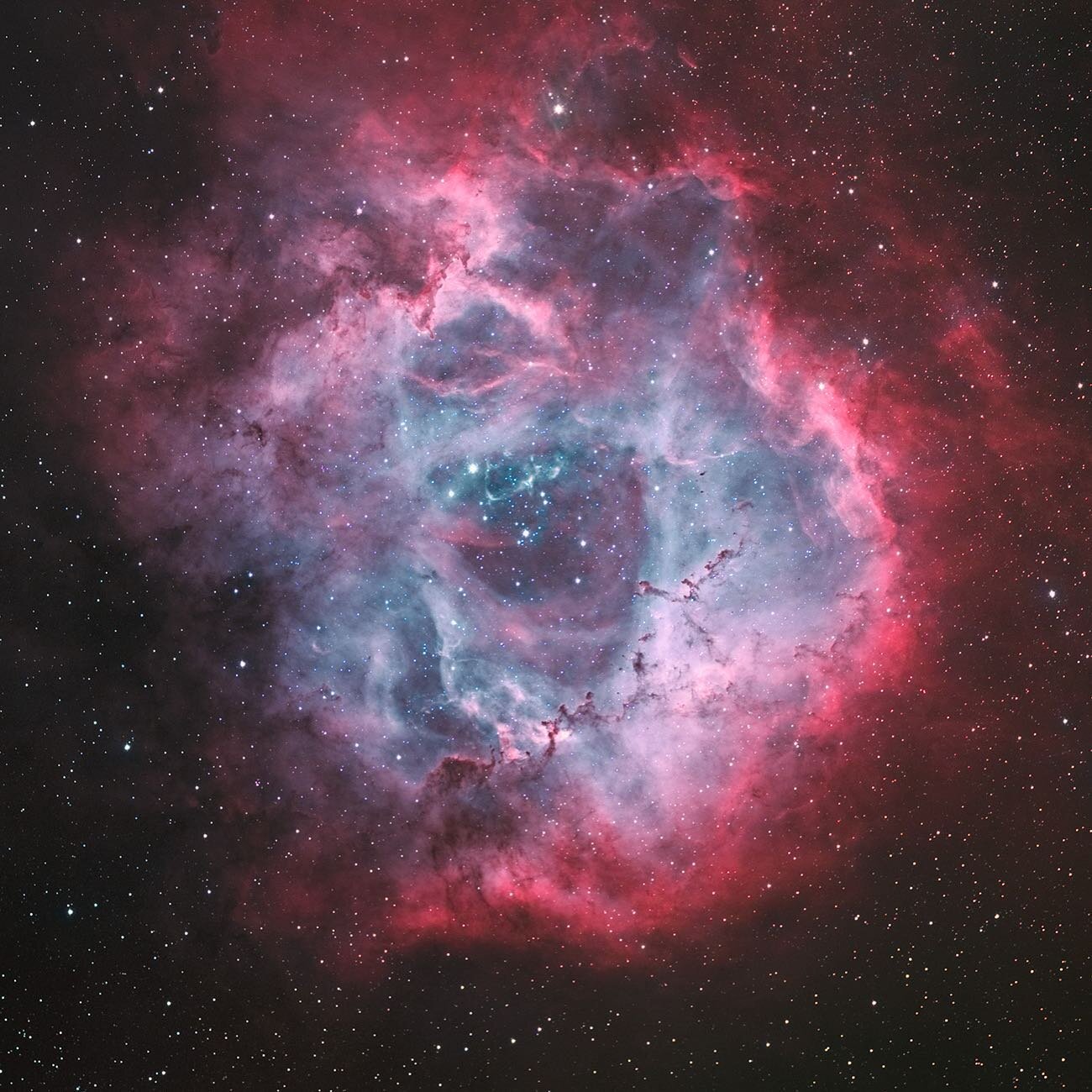
The Rosette Nebula (please click on image for larger presentation) is approximately 5500 light years from Earth and spans over 1 degree in the sky which is more than 5 full moons. The nebula itself has different NGC designations including 2223, 2238, 2239, and 2246. The open star cluster in the middle of the nebula is designated as NGC 2244. The nebula is located in the constellation Monoceros.
This image is another in my continuing experimentation with using Adobe Light Room and Photoshop exclusively in post-processing. I actually selected only 11 of the best images I had for this object taken during the Winter Star Party in February 2009. The 11 images were each 3.5 minutes in exposure at ISO 1600 for a total exposure time of 40 minutes. ISO 1600 was used as a compromise to maximize exposure time due to the sporadic cloudiness that was present. The telescope used was a Tom Back 92mm signature series refractor at approximately f4 and a focal length of about 400mm. The camera used was a modified Canon 450D. So far, I am very happy with the results of the Adobe processing work flow. The only question that I have is how well with this process work on hydrogen alpha images. I hope to do some experimentation with this in the coming weeks. I hope you enjoy the image and please drop me a line if you get a chance.
Kirk Rogers featured on Maine TV show
Please take a moment to visit my good friend and wonderful photographer Kirk Rogers' website for a video clip that presents Kirk's astrophotography to the viewers in Maine, U.S.A. The clip is approximately 5 minutes long and shows Kirk's equipment, images, and the observatory of Rob Burgess where Kirk's gear is housed. Congratulations to Kirk on the feature and I hope you enjoy the show.
Bill Green's Maine featuring the Astrophotography of Kirk Rogers
The only mount I will ever need

You may never have heard of the Astro-Physics Mach1 GTO mount before, but it is a beautiful piece of equipment that should prove to be the only mount I will ever need. I have had experience with numerous astrophotography mounts over the years including the Losmandy GM8, G11, and Titan as well as the Astro-Physics 600E QMD, 600E GTO, 900 GTO, and 1200 GTO. The Mach1 offers the astro-imager the most rigid and stable mount in a very portable package. The mount is capable of being used in a fixed location observatory or as a portable mount for remote high mountain imaging from the darkest skies possible.
Any mount this size eventually has a limitation as to how big of a scope it can carry. But my astro-imaging compositions require relatively small instruments and I don't believe my scope requirements will ever outgrow the capabilities of the Mach1.
I just received the mount last week and have begun familiarizing myself with the functions and performance. My plan is to image with it next new moon and I hope to have results for you a few days after that.
So until then...clear skies to you all and may you have wonderful photographic opportunities.
The Herschel 400 Astronomical League Project is underway
It’s not too late to join. We are about 30 objects into the Herschel 400. Hope to get another session in soon. Please subscribe to the YouTube channel so you get notifications on LIVE STREAMS.
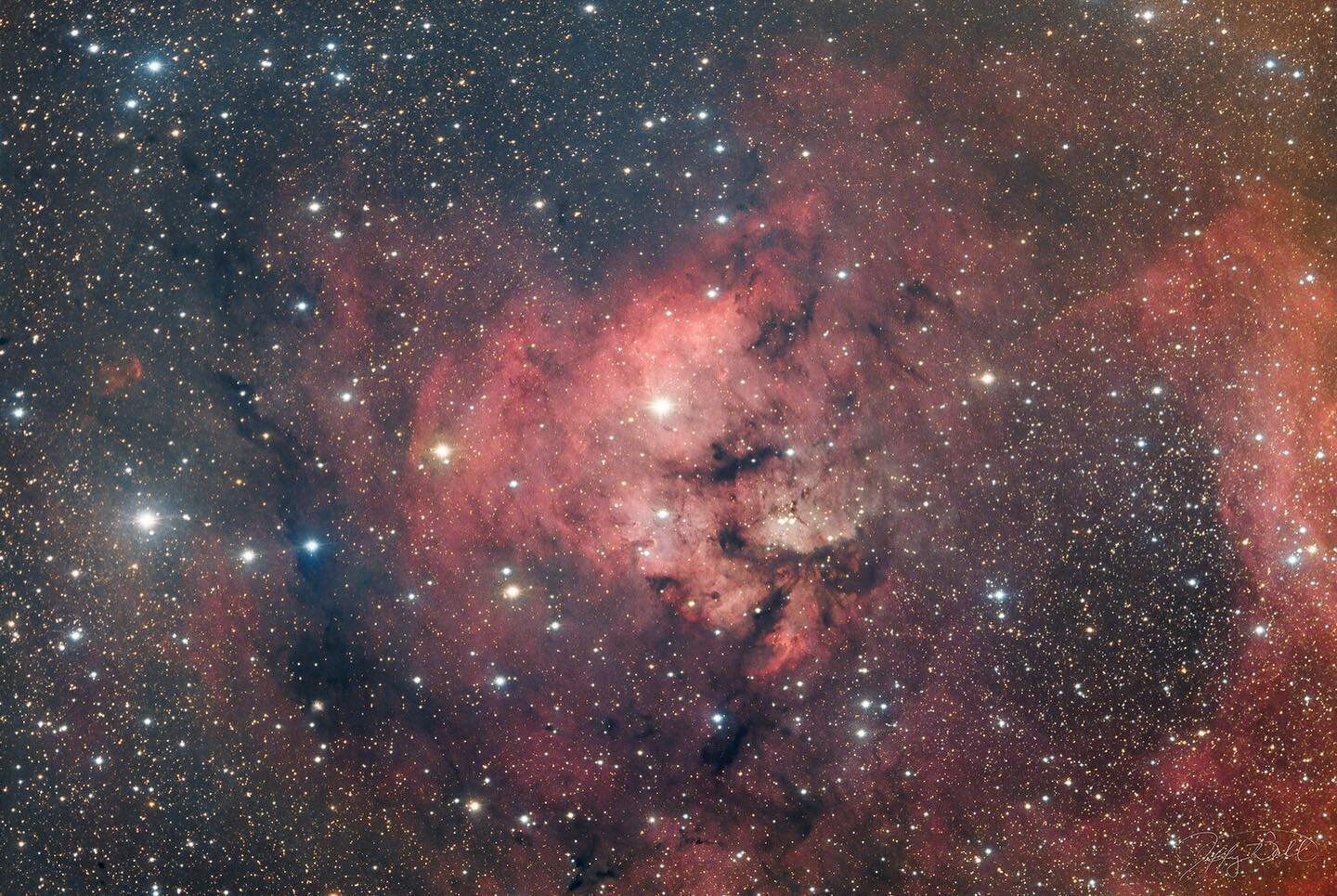
Angels in Monoceros: The Monoceros M2 Complex
The Monoceros R2 molecular complex (often shortened to Mon R2) is a massive giant molecular cloud and one of the nearest active star-forming regions to Earth. It's a dynamic stellar nursery embedded in dense gas and dust, where new stars—particularly massive ones—are actively being born.
Key Facts
Location: Southwestern part of the constellation Monoceros (the Unicorn), near the border with Orion. It's part of the larger Orion-Monoceros cloud complex.
Distance: Approximately 2,400–2,700 light-years (around 830 parsecs).
Size and Structure: The main dense core is relatively compact (a few light-years across), but the overall molecular cloud and associated nebulae span a wide area—reflection nebulae alone stretch up to about 2° in the sky. It's situated well below the galactic plane, which makes it stand out in certain observations.
Age and Activity: Star formation here began roughly 6–10 million years ago. It hosts an OB association (young, hot, massive B- and A-type stars) that illuminates surrounding dust, creating prominent reflection nebulae with bluish hues. There's also significant emission from ionized gas (red glows) and dark nebulae that appear as shadowy silhouettes blocking background light.
Notable Features:
A central hub of massive star formation with embedded clusters, molecular outflows, and HII regions.
Infrared observations (like those from VISTA or 2MASS) penetrate the dust to reveal hidden young stars and protoplanetary disks.
It's a key site for studying early stellar evolution, variability in young stellar objects (YSOs), and the interplay between massive stars and their natal clouds.
The most famous and photogenic part of Mon R2 is the region around NGC 2170 (the Angel Nebula), a striking reflection nebula with wing-like dust structures, glowing blue from scattered starlight, mixed with red emission and dark lanes. Wider views of the complex reveal a richer tapestry of colorful gas, dust filaments, and star clusters.
Credit: GROK 2/28/26
Click on image for larger view.
New Astro Camera: OM-3
Join me for a LIVE conversation about this new astro camera coming to the market. Is this the best option for you? How does it compare to other options? https://www.earthandskyphoto.com Correction: when discussing Bulb mode with Canon, I incorrectly said it had a limit of 30”. I meant to say manual exposure has a max of 30”. In bulb, you need to use a remote control or app for exposure time control. The problem is you can’t set exposure time for stills in the camera menu. I was made aware that Olympus no longer owns the OM system. It is owned by Japanese industrial Partners, a private equity firm. For content on the OM-3 for astrophotography, please see Ben Chapell’s Narrow Band channel. https://youtube.com/@TheNarrowbandChannel?si=GcWY-BM9skG9LPhY
Jeff's Blog
Join me on photography journeys from desert landscapes to deep sky wonders.