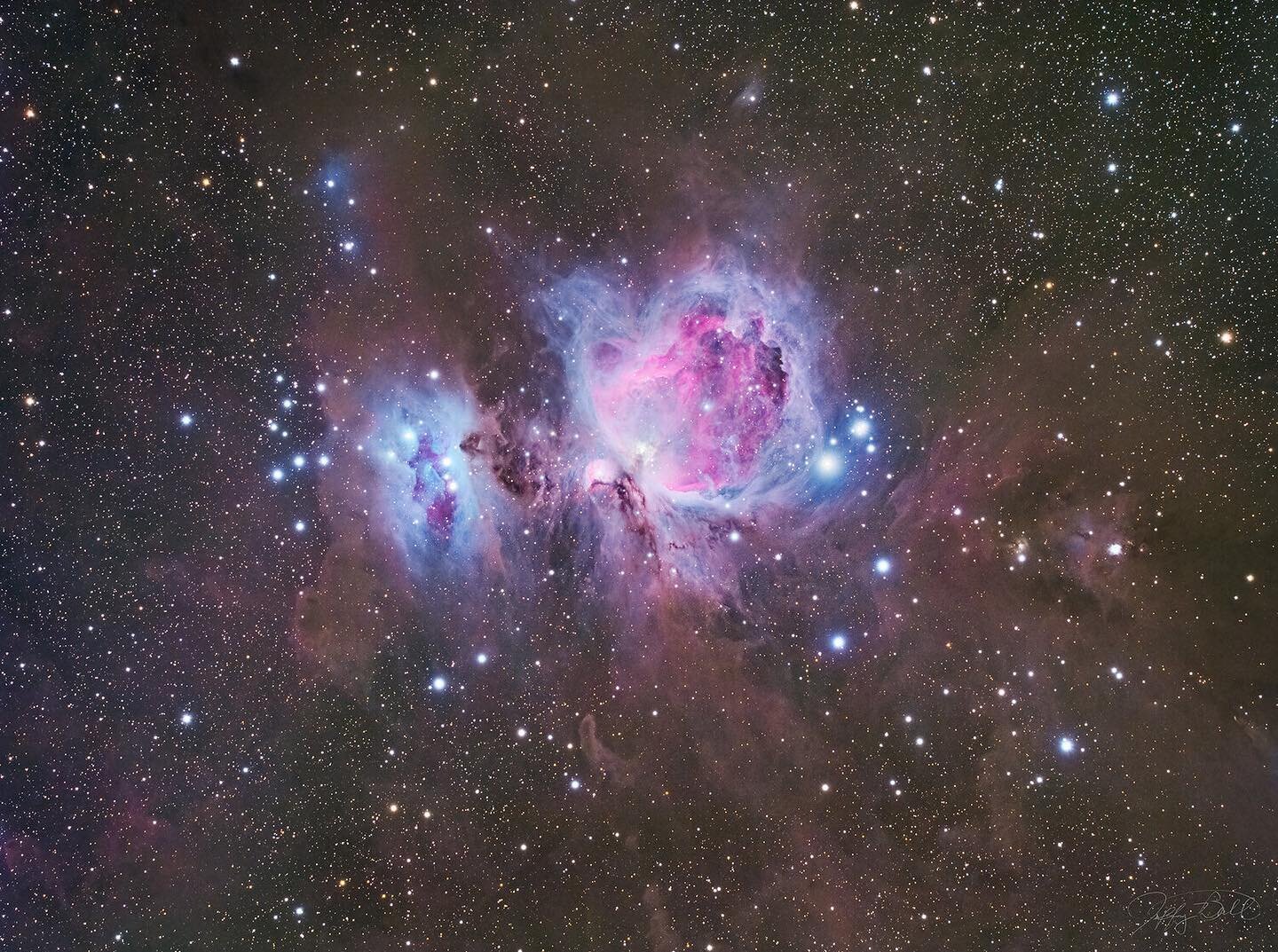
The Herschel 400 Astronomical League Project is underway
It’s not too late to join. We are about 30 objects into the Herschel 400. Hope to get another session in soon. Please subscribe to the YouTube channel so you get notifications on LIVE STREAMS.
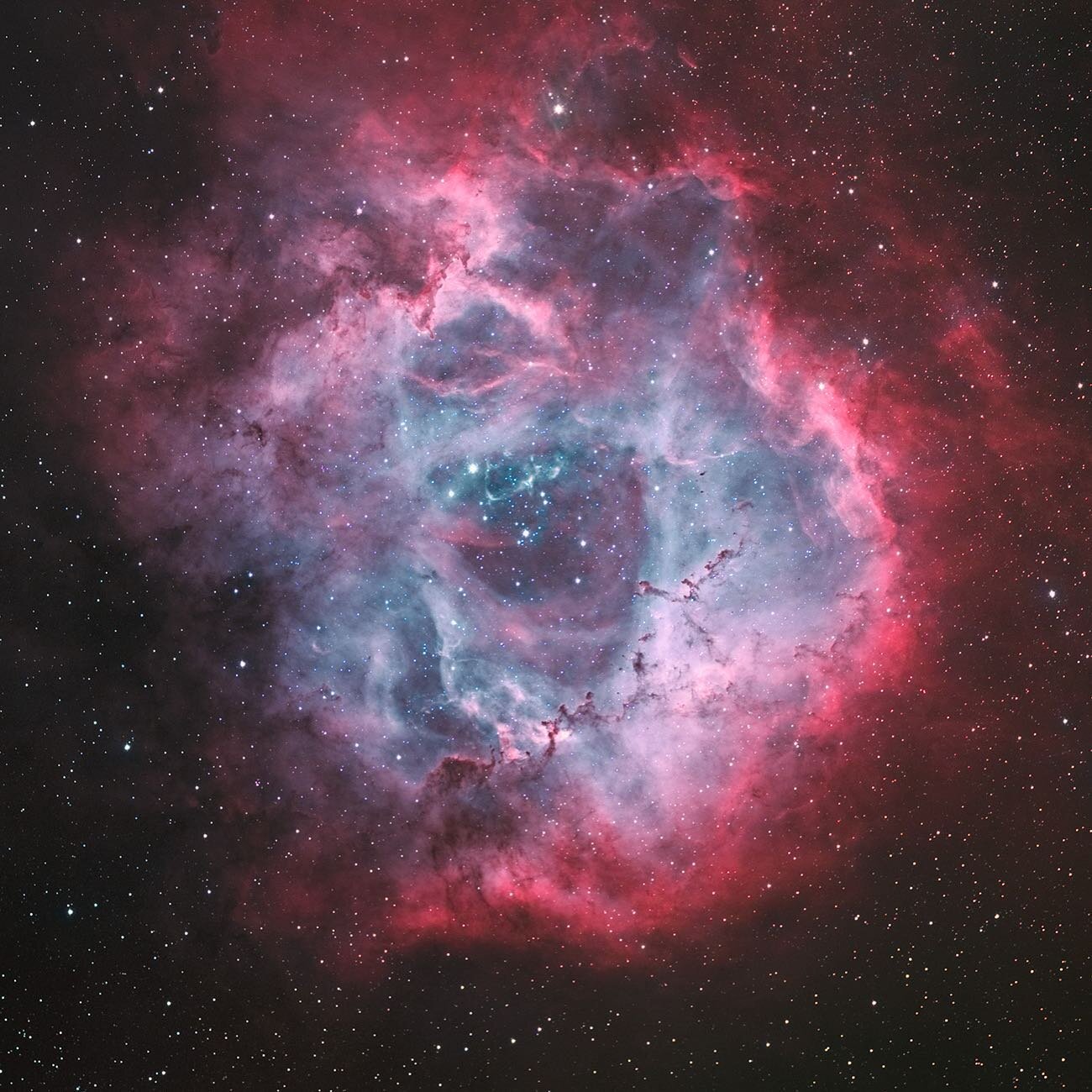
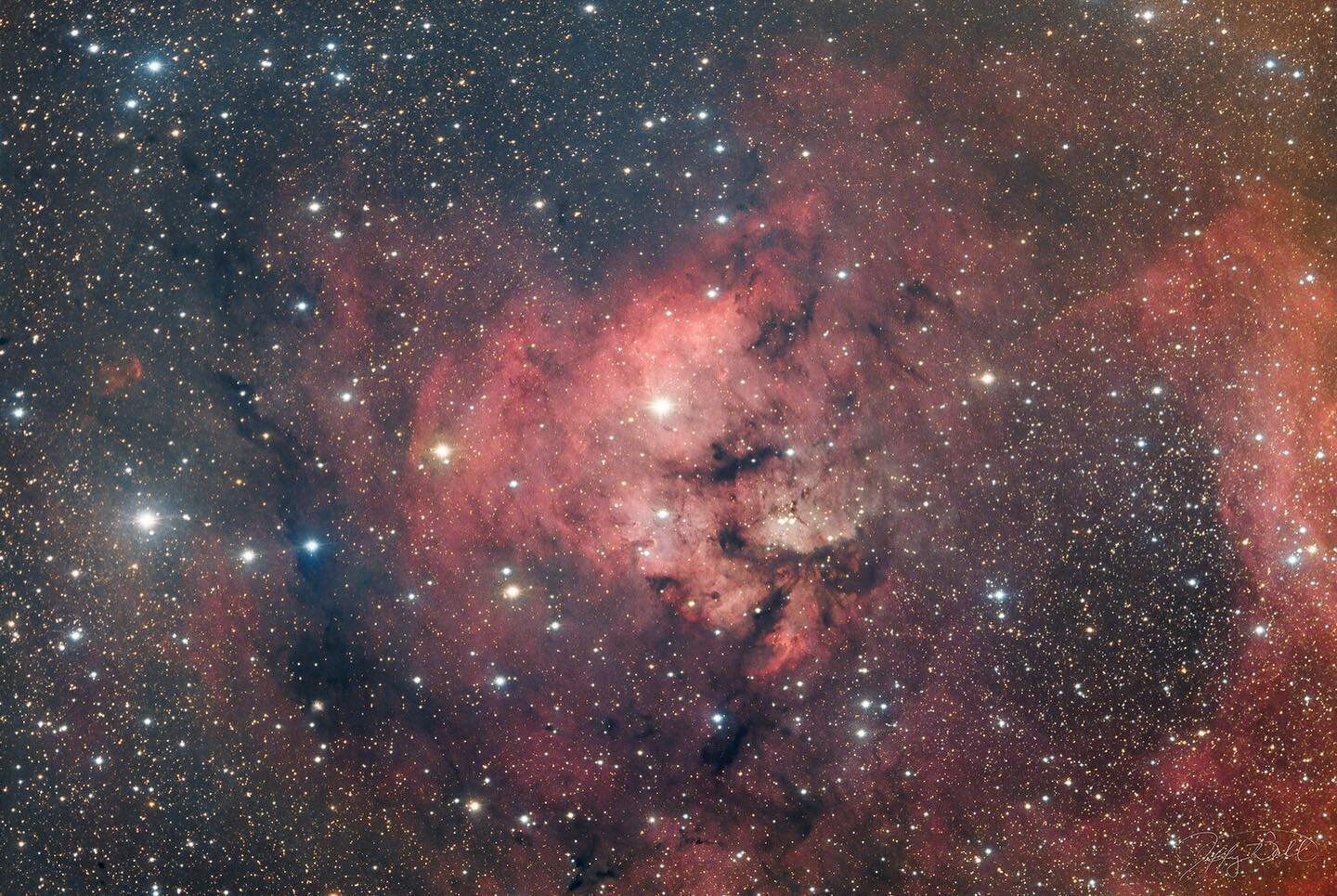
Angels in Monoceros: The Monoceros M2 Complex
The Monoceros R2 molecular complex (often shortened to Mon R2) is a massive giant molecular cloud and one of the nearest active star-forming regions to Earth. It's a dynamic stellar nursery embedded in dense gas and dust, where new stars—particularly massive ones—are actively being born.
Key Facts
Location: Southwestern part of the constellation Monoceros (the Unicorn), near the border with Orion. It's part of the larger Orion-Monoceros cloud complex.
Distance: Approximately 2,400–2,700 light-years (around 830 parsecs).
Size and Structure: The main dense core is relatively compact (a few light-years across), but the overall molecular cloud and associated nebulae span a wide area—reflection nebulae alone stretch up to about 2° in the sky. It's situated well below the galactic plane, which makes it stand out in certain observations.
Age and Activity: Star formation here began roughly 6–10 million years ago. It hosts an OB association (young, hot, massive B- and A-type stars) that illuminates surrounding dust, creating prominent reflection nebulae with bluish hues. There's also significant emission from ionized gas (red glows) and dark nebulae that appear as shadowy silhouettes blocking background light.
Notable Features:
A central hub of massive star formation with embedded clusters, molecular outflows, and HII regions.
Infrared observations (like those from VISTA or 2MASS) penetrate the dust to reveal hidden young stars and protoplanetary disks.
It's a key site for studying early stellar evolution, variability in young stellar objects (YSOs), and the interplay between massive stars and their natal clouds.
The most famous and photogenic part of Mon R2 is the region around NGC 2170 (the Angel Nebula), a striking reflection nebula with wing-like dust structures, glowing blue from scattered starlight, mixed with red emission and dark lanes. Wider views of the complex reveal a richer tapestry of colorful gas, dust filaments, and star clusters.
Credit: GROK 2/28/26
Click on image for larger view.
New Astro Camera: OM-3
Join me for a LIVE conversation about this new astro camera coming to the market. Is this the best option for you? How does it compare to other options? https://www.earthandskyphoto.com Correction: when discussing Bulb mode with Canon, I incorrectly said it had a limit of 30”. I meant to say manual exposure has a max of 30”. In bulb, you need to use a remote control or app for exposure time control. The problem is you can’t set exposure time for stills in the camera menu. I was made aware that Olympus no longer owns the OM system. It is owned by Japanese industrial Partners, a private equity firm. For content on the OM-3 for astrophotography, please see Ben Chapell’s Narrow Band channel. https://youtube.com/@TheNarrowbandChannel?si=GcWY-BM9skG9LPhY
Light Room 3.0 for Astronomical Images
I recently upgraded to LR 3.0 and had an opportunity to work up an Omega Centauri Globular Cluster image. One of the upgraded features in LR 3.0 is an enhanced noise reduction tool. The new noise reduction seems to have smarter power. Meaning that is applies a stronger smoothing effect to the image while still preserving detail. Now remember some of these astronomical images contain the worst noise you can imagine. The particular screen shot here is of a 1 minute exposure at ISO 6400. I couldn't even take this photograph one year ago at those settings. So technology and software have come a long way in noise reduction. The screen is a split screen image. The image on the left is before noise reduction and the image on the right is after noise reduction has been applied.
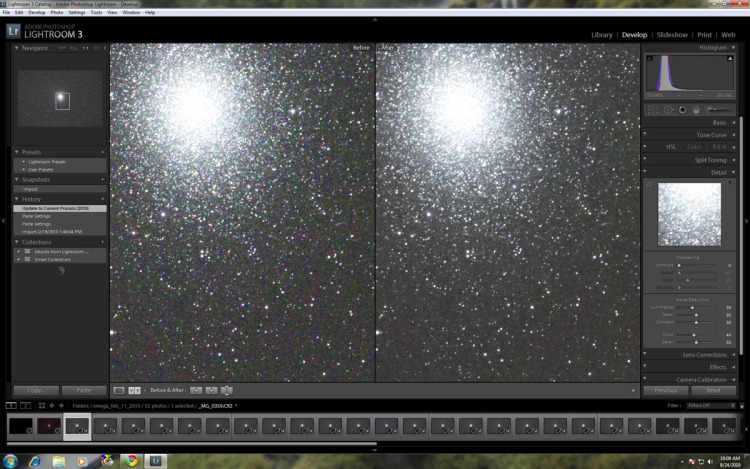
The settings I use in this screen shot are for demonstration purposes. You can clearly see the benefit is strongest in color noise reduction. While there is still some color mottling, it is reduced greatly and the high value color noise levels are reduced dramatically. The ISO 6400 images were used to capture the extension of the globular cluster and ultimately a lower ISO image was used for the stars and background sky. But it is very encouraging to see such a noise reduction capability with ISO 6400. I tend to not apply too much luminosity reduction as the image will realize a noise reduction through stacking of multiple images. But the color noise reduction is one that really helps smooth the background sky and when stacked leads to a very clean and neutral sky background.
Once again, when it comes to utilizing a DSLR for astronomical imaging things are only getting better.
To learn more about image processing please see my "Learn Digital Photography" menu item above for customized education in Light Room or Photoshop.
The Granddaddy of Them All
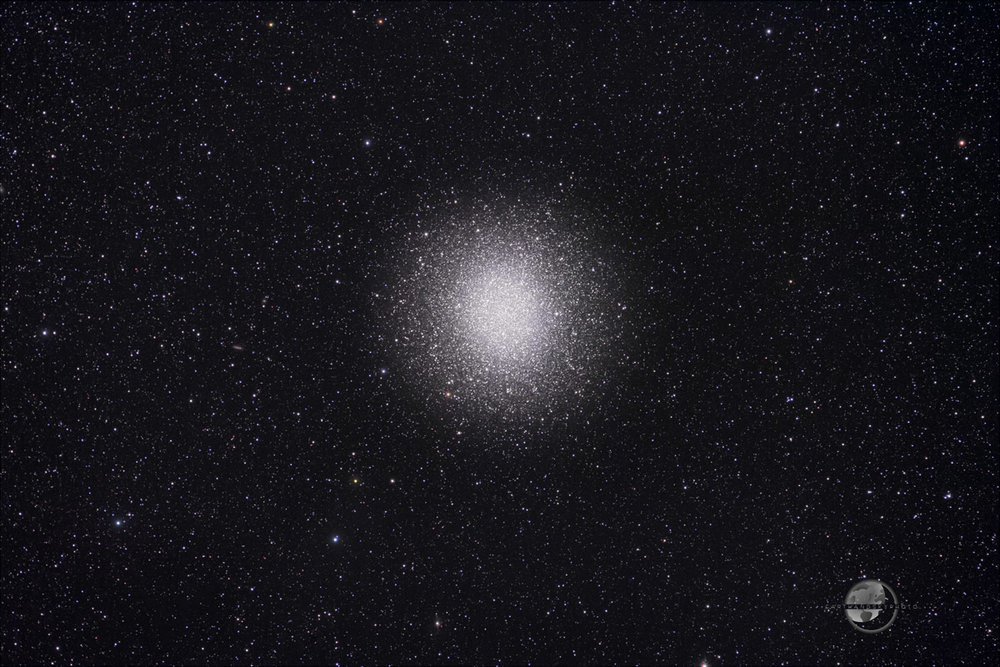 Omega CentauriThe grand-daddy of them all. The globular cluster in Centaurus is the biggest and brightest in the Milky Way Galaxy. It is estimated that over 10 million stars are rotating around the cluster's core. The cluster is designated as NGC 5139 on star charts and lies over 18 thousand light years away. The cluster is 150 light years across and is estimated to be over 12 billion years old! It is a glorious sight in a telescope and is best viewed from southern latitudes. This image was taken during the 2010 Winter Star Party in the Florida Keys.
Technical details: Images were acquired with a modified Canon T1i on a Takahashi 85 FSQ with focal reducer. The tracking mount used was an Astro-Physics Mach1 GTO. Images were converted in Adobe Light Room 3.0, combined with DeepSky Stacker, and enhanced in Adobe Photoshop CS5. There are approximately 60 images combined with varying ISOs to obtain the final image.
The image may be seen in larger portfolio presentation in the Color Astrophotography Gallery.
An Early Favorite...
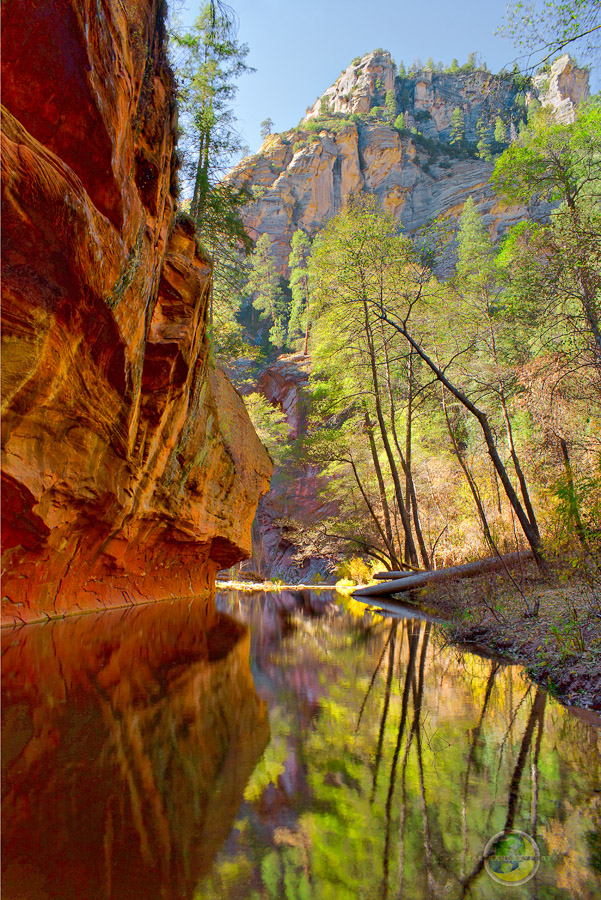 West Fork of Oak Creek, Sedona, AZIt is impossible to carry all of my prints framed. So I display some prints in matted presentations in various sizes. One print is quickly becoming a crowd favorite, "West Fork of Oak Creek." The print is stunning in color and detail and represents a glorious day of hiking on the West Fork of Oak Creek trail from 2006. The trail is just north of Sedona, AZ and is a wonderful day hike for any visitor to the area.
The print is now receiving full gallery treatment with a wonderful new frame available from Mayne Framing. The framed print will now be a "featured" print in the Shadyside Show in Pittsburgh next weekend along with 5 other landscape prints and 5 astronomical prints.
If you are in the Pittsburgh area please come by and see the show and the new presentation of "West Fork of Oak Creek Canyon." I think you will find the print very enjoyable and perhaps one you cannot live without.
Got dark skies?
 Star Tree from 2009 AHSPOne of my highlights for the year is getting to the highlands of West Virginia and soaking up the starlight under the best dark skies east of the Mississippi. If you have never seen a truly dark sky or have the need to get out under one, I highly recommend checking out the Almost Heaven Star Party this coming Labor Day weekend.
The star party is co-hosted by the Mountain Institute on Spruce Knob, West Virginia's highest point at nearly 5,000 feet above see level, and the Northern Virginia Astronomers Club (NOVAC). Both organizations are fantastic and it is a very well run event.
NOVAC has chosen an image I took from last year's event as the representative image for the 2010 event. "Star Tree" was captured on a pristine night of star gazing and represents the best that the highlands of West Virginia has to offer the amateur astronomer in the early fall of the year.
For much more information and to register please see this link to the Almost Heaven Star Party.
Highly recommended!!!
Fine Art Booth Display at Myrtle Beach
Had a wonderful time at the Craftsman Classic Show in Myrtle Beach and continued to vacation with the family afterwards. It was hot as you might guess and what a wonderful time to have an indoor show! Met many wonderful people and had some great discussions about art and photography as well as the cosmos.
One customer made the comment that I didn't expect but was overjoyed when they said that "I see God in your photographs." That really said it all and made my show.
I met many new customers, signed several folks up for the email newsletter, and had a registration for the Water workshop next May.
For those who didn't make it to the show, I have posted a video where I walk through the booth and give you a brief glimpse of what the presentation looked like.
The next show is in Pittsburgh the last weekend in August. For more information please see the "Purchase-Art Show" page in the menu above.
Jeff's Blog
Join me on photography journeys from desert landscapes to deep sky wonders.