Film about "Father of Color Photography"
As I continue my studies of photography, 2007 looks to be one in which I delve deeper into the strict study of color photography. One of the most influential figures in the history of color photography is William Eggleston. He is of particular interest to me since my maternal grandparents had the surname Eggleston. I am currently reading one of Eggleston's books (William Eggleston's Guide) and also discovered that there is a movie scheduled for release about Eggleston and his life for this February titled "By the Ways." The story looks quite interesting and I look forward to seeing the film if it is released on a national basis. I look forward to my yearlong investment in color photography studies and invite you to join me on this journey as we discuss the craft of color photography.
We are...Marshall!
Today marks an historic day for my community and Alma mater. Last April, Hollywood came to Huntington, WV to begin telling the story of tragedy and survival. Today "We are...Marshall!" is released in theaters across the nation. The story is true and I believe will touch the hearts of all who see it. It is hard for me to be objective about the whole story so I won't offer a review of the movie here, but I can share with you that I believe the movie will touch your heart in a special way. In some ways, the movie helps to explain many Huntingtonians "can do" attitude in the face of what can be overwhelming odds to succeed given our economic misfortunes in the Appalachia region. Director McG has described the movie as one about tragedy and how a community deals with grieving and starts on a path toward survival and ultimately success. If you are looking for an uplifting movie this holiday season, I believe you will find this one will meet your needs. If you have a moment this holiday season, take in some cinematic art and view We are...Marshall!
more on the movie We are...Marshall!
HDR article at PopPhoto
I stumbled across a wonderful article on High Dynamic Range processing at PopPhoto. The article looks at the HDR function of Photoshop, but more importantly looks at the wonderful new program Photomatix and how it produces HDR and tone mapping. It even compares the two. My intial use of Photomatix has been extremely positive and I encourage you to take a look at the program for HDR and tone mapping. A definite must-read for anyone looking at the latest in photographic enhancement techniques.
To read the article please click here...
Alain Briot Interview Part 2
Part 2 of the Alain Briot interview is now available either through your iTunes player or directly through Feedburner. Alain discusses his attitude toward learning and how that attitude influences his teaching and his writing.
Spaceweather-want to see an aurora?
Sometimes I have to chuckle at our technology today and what we can do vs. just a few years ago. One of the great aids to photographing the night sky is the website spaceweather.com One of the main features of Spaceweather is the presentation of geomagnetic storm data and the uncanny ability to now predict when an aurora will take place. Not only can we predict the aurora, but the prediction is pretty darn accurate as to how far south one could expect to see the aurora. On December 14 an aurora event took place and the predictions were dead on target. The website is full of wonderful aurora photographs from that particular display from Norway to Arizona! You can even register for an "aurora alert" that will notify you as to when an aurora is likely to occur at your location. I just think that is so awesome! There are many other astronomical measurements at Spaceweather as well from asteroids to the ISS. But for me and other fellow photographers, nothing is more useful than the aurora prediction capability and for that I am at the same time grateful and awed by our technological capabilities of today.
The Herschel 400 Astronomical League Project is underway
It’s not too late to join. We are about 30 objects into the Herschel 400. Hope to get another session in soon. Please subscribe to the YouTube channel so you get notifications on LIVE STREAMS.
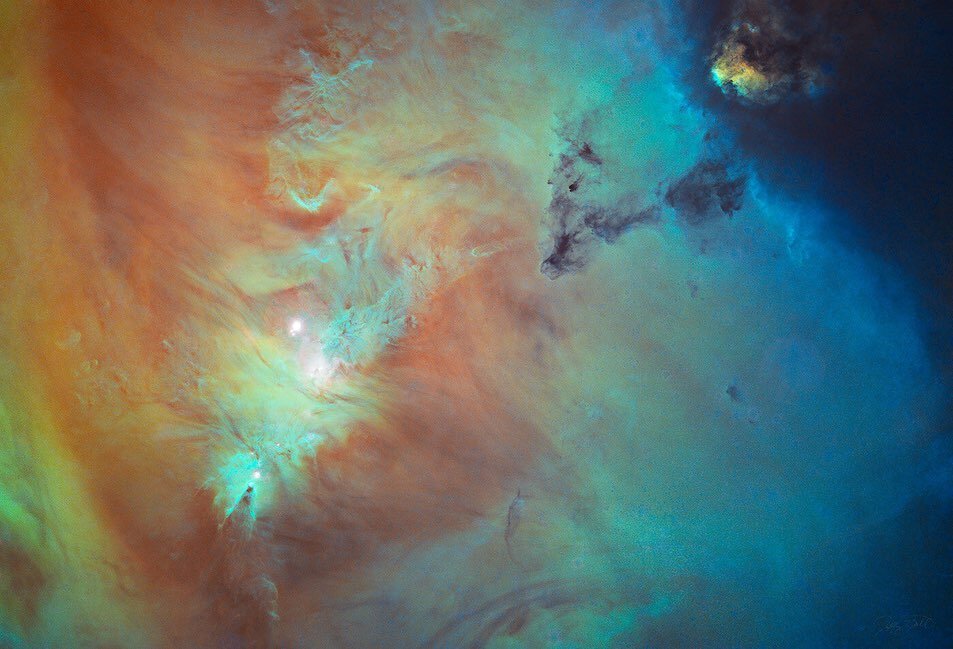
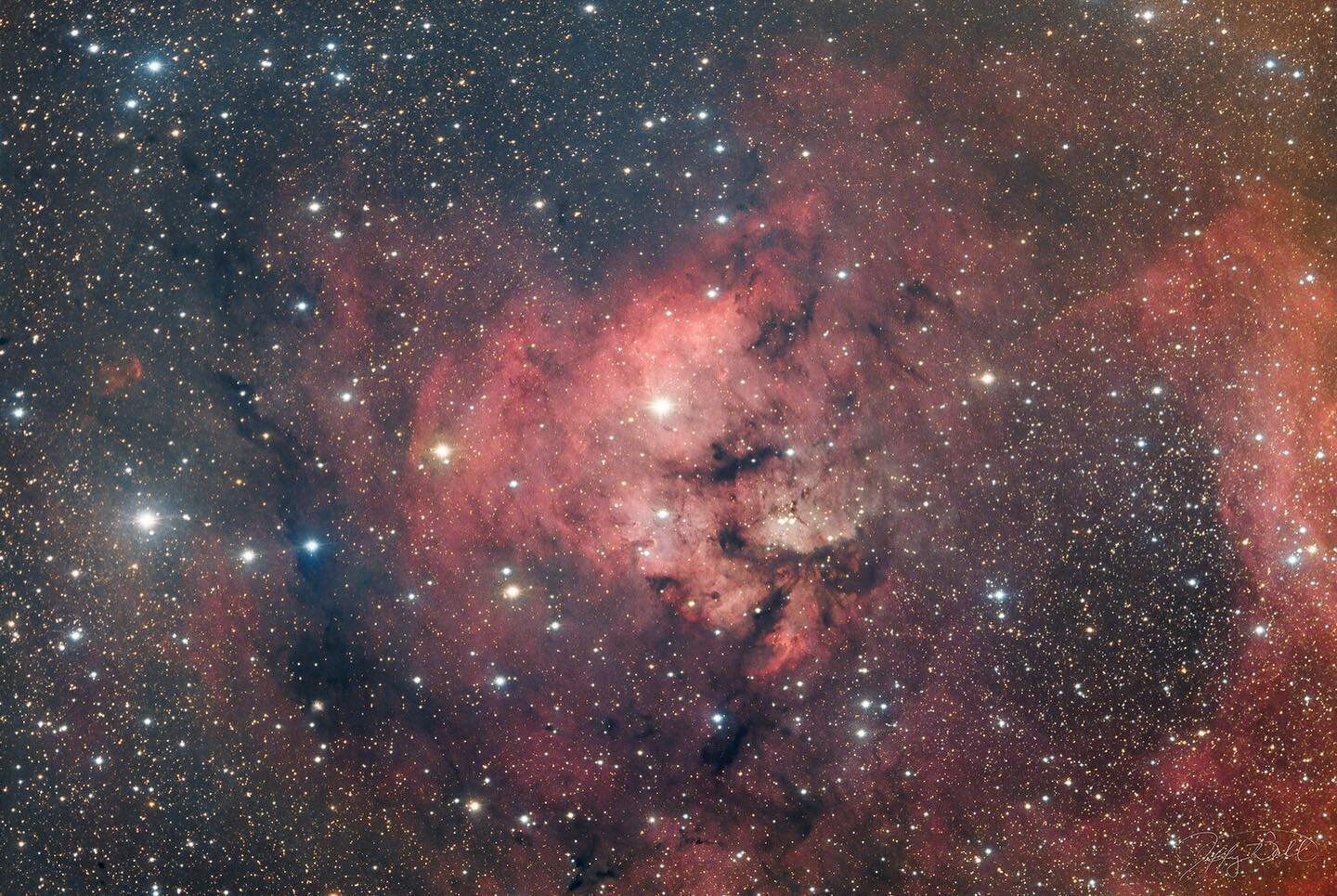
Angels in Monoceros: The Monoceros M2 Complex
The Monoceros R2 molecular complex (often shortened to Mon R2) is a massive giant molecular cloud and one of the nearest active star-forming regions to Earth. It's a dynamic stellar nursery embedded in dense gas and dust, where new stars—particularly massive ones—are actively being born.
Key Facts
Location: Southwestern part of the constellation Monoceros (the Unicorn), near the border with Orion. It's part of the larger Orion-Monoceros cloud complex.
Distance: Approximately 2,400–2,700 light-years (around 830 parsecs).
Size and Structure: The main dense core is relatively compact (a few light-years across), but the overall molecular cloud and associated nebulae span a wide area—reflection nebulae alone stretch up to about 2° in the sky. It's situated well below the galactic plane, which makes it stand out in certain observations.
Age and Activity: Star formation here began roughly 6–10 million years ago. It hosts an OB association (young, hot, massive B- and A-type stars) that illuminates surrounding dust, creating prominent reflection nebulae with bluish hues. There's also significant emission from ionized gas (red glows) and dark nebulae that appear as shadowy silhouettes blocking background light.
Notable Features:
A central hub of massive star formation with embedded clusters, molecular outflows, and HII regions.
Infrared observations (like those from VISTA or 2MASS) penetrate the dust to reveal hidden young stars and protoplanetary disks.
It's a key site for studying early stellar evolution, variability in young stellar objects (YSOs), and the interplay between massive stars and their natal clouds.
The most famous and photogenic part of Mon R2 is the region around NGC 2170 (the Angel Nebula), a striking reflection nebula with wing-like dust structures, glowing blue from scattered starlight, mixed with red emission and dark lanes. Wider views of the complex reveal a richer tapestry of colorful gas, dust filaments, and star clusters.
Credit: GROK 2/28/26
Click on image for larger view.
New Astro Camera: OM-3
Join me for a LIVE conversation about this new astro camera coming to the market. Is this the best option for you? How does it compare to other options? https://www.earthandskyphoto.com Correction: when discussing Bulb mode with Canon, I incorrectly said it had a limit of 30”. I meant to say manual exposure has a max of 30”. In bulb, you need to use a remote control or app for exposure time control. The problem is you can’t set exposure time for stills in the camera menu. I was made aware that Olympus no longer owns the OM system. It is owned by Japanese industrial Partners, a private equity firm. For content on the OM-3 for astrophotography, please see Ben Chapell’s Narrow Band channel. https://youtube.com/@TheNarrowbandChannel?si=GcWY-BM9skG9LPhY
Jeff's Blog
Join me on photography journeys from desert landscapes to deep sky wonders.